
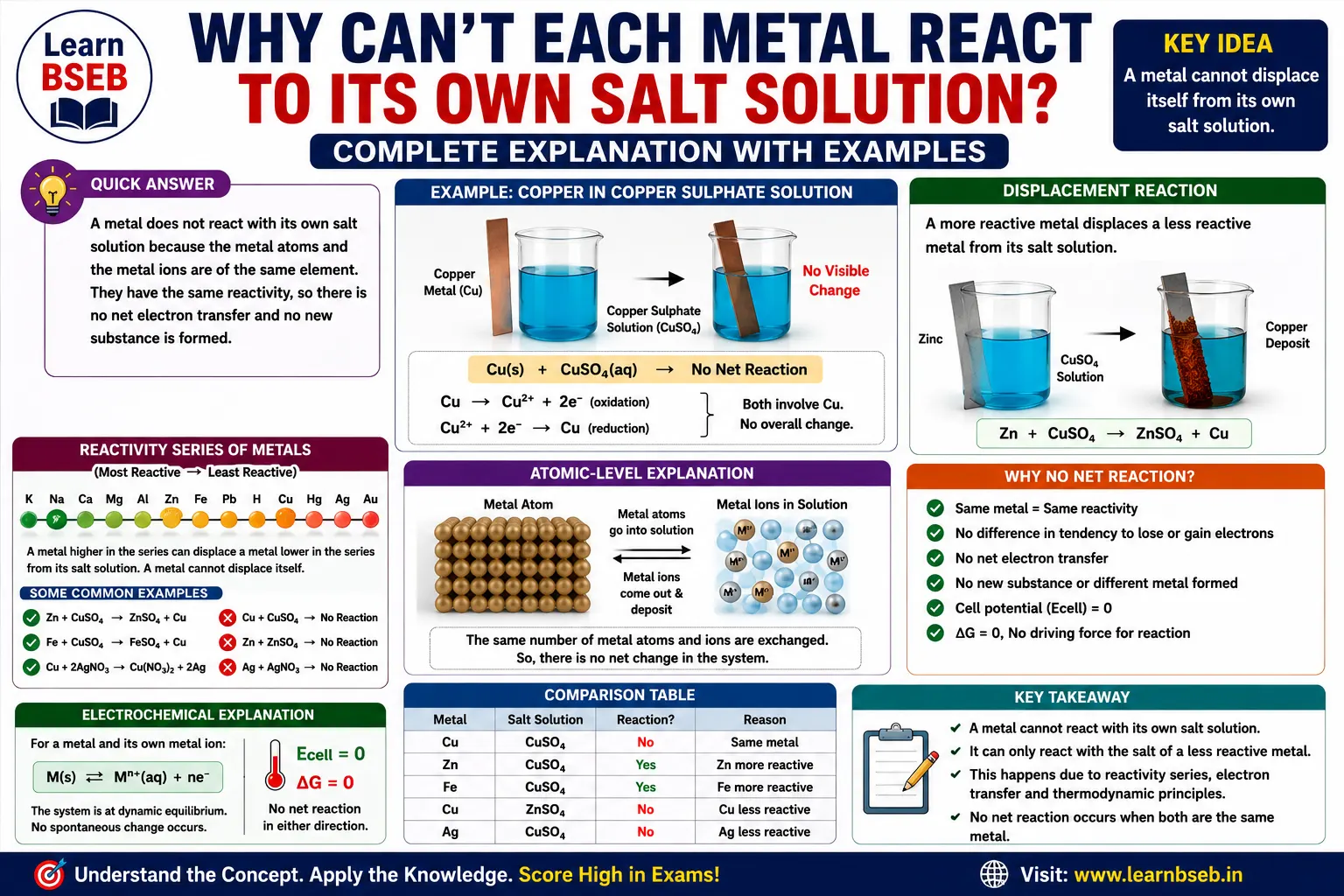
A metal generally does not show a visible chemical reaction when placed in a solution of its own salt because the metal atoms and the metal ions in the solution belong to the same element.
For example, when a copper strip is placed in copper sulphate solution, the system contains:
- Copper atoms in the metal strip
- Copper ions in the solution
- Sulphate ions in the solution
A copper atom may lose electrons and enter the solution as a copper ion. At the same time, a copper ion from the solution may gain electrons and deposit on the copper strip. Since both processes involve the same element, there is no overall chemical change under ordinary conditions.
The reaction appears to be:
Cu + CuSO₄ → No net reaction
This does not mean that atoms and ions are completely motionless. At the microscopic level, oxidation and reduction may occur in opposite directions at equal rates. However, because the same metal is being exchanged, there is no visible displacement, no change in colour and no new substance formed.
This article explains why a metal does not react with its own salt solution, how displacement reactions work, why reactivity series is important, what happens at the atomic level and how this concept differs from a metal reacting with the salt of another metal.
Quick Answer
A metal cannot produce a net displacement reaction with its own salt solution because it cannot displace itself.
The metal atoms and the metal ions are of the same element. Their tendency to lose or gain electrons is the same. Therefore, no net electron transfer, no change in oxidation state and no new substance are produced.
For example:
Cu(s) + Cu²⁺(aq) → Cu²⁺(aq) + Cu(s)
The substances on both sides are effectively the same. Therefore, there is no overall reaction.
What Does “A Metal Reacting with Its Own Salt” Mean?
A salt is an ionic compound made of positive and negative ions.
For example:
- Copper sulphate contains Cu²⁺ and SO₄²⁻ ions.
- Zinc sulphate contains Zn²⁺ and SO₄²⁻ ions.
- Iron sulphate contains Fe²⁺ and SO₄²⁻ ions.
- Silver nitrate contains Ag⁺ and NO₃⁻ ions.
When we say “a metal is placed in its own salt solution,” we mean situations such as:
- Copper in copper sulphate solution
- Zinc in zinc sulphate solution
- Iron in iron sulphate solution
- Silver in silver nitrate solution
Examples:
Cu metal + CuSO₄ solution
Zn metal + ZnSO₄ solution
Fe metal + FeSO₄ solution
In all these cases, the metal in solid form and the metal ion in solution are the same element.
What Is a Displacement Reaction?
A displacement reaction is a reaction in which a more reactive element displaces a less reactive element from its compound.
General form:
A + BC → AC + B
In metal displacement reactions:
More reactive metal + Salt of less reactive metal → Salt of more reactive metal + Less reactive metal
Example:
Zn + CuSO₄ → ZnSO₄ + Cu
Zinc is more reactive than copper. Therefore, zinc displaces copper from copper sulphate solution.
Another example:
Fe + CuSO₄ → FeSO₄ + Cu
Iron is more reactive than copper, so iron displaces copper.
However:
Cu + ZnSO₄ → No reaction
Copper is less reactive than zinc, so copper cannot displace zinc from zinc sulphate.
Why Can a Metal Not Displace Itself?
A displacement reaction requires a difference in reactivity.
For one metal to displace another metal from its salt, the free metal must have a greater tendency to lose electrons than the metal ion present in the solution.
For example:
Zinc atoms lose electrons more easily than copper atoms.
Therefore:
Zn → Zn²⁺ + 2e⁻
At the same time:
Cu²⁺ + 2e⁻ → Cu
The complete reaction is:
Zn + Cu²⁺ → Zn²⁺ + Cu
But consider copper in copper sulphate solution.
Oxidation possibility:
Cu → Cu²⁺ + 2e⁻
Reduction possibility:
Cu²⁺ + 2e⁻ → Cu
Both involve copper. If one copper atom enters the solution and one copper ion leaves the solution, the overall amount and nature of copper remain unchanged.
The net result is:
Cu + Cu²⁺ → Cu²⁺ + Cu
Nothing new is formed.
This is why a metal cannot displace itself from its own salt solution.
Reactivity Series and Metal Displacement
The reactivity series arranges metals according to their tendency to lose electrons and form positive ions.
A simplified reactivity series is:
Potassium > Sodium > Calcium > Magnesium > Aluminium > Zinc > Iron > Lead > Hydrogen > Copper > Mercury > Silver > Gold
A metal higher in the series can generally displace a metal lower in the series from its salt solution.
Examples
Zinc and Copper Sulphate
Zinc is above copper.
Zn + CuSO₄ → ZnSO₄ + Cu
Reaction occurs.
Iron and Copper Sulphate
Iron is above copper.
Fe + CuSO₄ → FeSO₄ + Cu
Reaction occurs.
Copper and Iron Sulphate
Copper is below iron.
Cu + FeSO₄ → No reaction
Copper and Copper Sulphate
Copper and copper are at the same position because they are the same metal.
There is no reactivity difference.
Cu + CuSO₄ → No net reaction
Atomic-Level Explanation
To understand the reaction deeply, we must distinguish between a metal atom and a metal ion.
Metal Atom
A metal atom is electrically neutral.
Example:
Copper atom:
Cu
It contains equal numbers of protons and electrons.
Metal Ion
A metal ion is positively charged because it has lost one or more electrons.
Copper ion:
Cu²⁺
Zinc ion:
Zn²⁺
Silver ion:
Ag⁺
When a metal reacts with the salt of another metal, electrons move from the more reactive metal atoms to the less reactive metal ions.
Example:
Zn + Cu²⁺ → Zn²⁺ + Cu
Zinc loses electrons:
Zn → Zn²⁺ + 2e⁻
Copper ions gain electrons:
Cu²⁺ + 2e⁻ → Cu
But when copper metal is placed in copper ion solution, both oxidation and reduction involve copper.
Possible forward process:
Cu atom → Cu²⁺ ion
Possible reverse process:
Cu²⁺ ion → Cu atom
The system does not gain a new product because copper is replaced by copper.
Net Ionic Equation
The idea becomes clearer using net ionic equations.
Zinc in Copper Sulphate
Full equation:
Zn + CuSO₄ → ZnSO₄ + Cu
Ionic form:
Zn + Cu²⁺ + SO₄²⁻ → Zn²⁺ + SO₄²⁻ + Cu
Sulphate ions remain unchanged and are spectator ions.
Net ionic equation:
Zn + Cu²⁺ → Zn²⁺ + Cu
This is a real chemical change.
Copper in Copper Sulphate
Possible expression:
Cu + Cu²⁺ + SO₄²⁻ → Cu²⁺ + SO₄²⁻ + Cu
After cancelling identical species, nothing remains.
There is no net ionic equation.
Therefore, there is no overall chemical reaction.
Electron Transfer Explanation
Displacement reactions are redox reactions.
Oxidation
Loss of electrons is oxidation.
Example:
Zn → Zn²⁺ + 2e⁻
Reduction
Gain of electrons is reduction.
Example:
Cu²⁺ + 2e⁻ → Cu
In a proper displacement reaction:
- One metal is oxidised.
- Another metal ion is reduced.
But in the case of a metal and its own salt:
- The same type of atom may be oxidised.
- The same type of ion may be reduced.
There is no net difference between initial and final substances.
No permanent electron transfer produces a different element or compound.
Dynamic Equilibrium at the Metal-Solution Surface
At a more advanced level, when a metal is placed in a solution containing its own ions, a dynamic equilibrium may develop at the surface.
For a metal M:
M(s) ⇌ Mⁿ⁺(aq) + ne⁻
Some metal atoms may leave the surface and enter the solution as ions.
At the same time, some metal ions from the solution may gain electrons and deposit on the metal surface.
When both processes occur at equal rates, equilibrium is established.
There may be microscopic exchange, but:
- The total amount of metal may remain nearly unchanged.
- The concentration of ions may remain nearly constant.
- No new metal is displaced.
- No visible reaction is observed.
This equilibrium is related to the electrode potential of the metal-metal ion system.
Electrochemical Explanation
Every metal-metal ion pair has an electrode potential.
Examples:
- Zn²⁺/Zn
- Cu²⁺/Cu
- Ag⁺/Ag
A spontaneous redox reaction requires a difference in electrode potential between two different half-cells or two different redox couples.
For zinc and copper:
- Zinc has a stronger tendency to oxidise.
- Copper ions have a stronger tendency to reduce compared with zinc ions.
Therefore, electron transfer occurs from zinc to copper ions.
But for copper metal and copper ions:
- Both belong to the same Cu²⁺/Cu redox couple.
- There is no potential difference between identical systems under the same conditions.
- The cell potential for an identical metal-metal ion combination is zero.
Therefore:
Ecell = 0
A zero cell potential means there is no driving force for a net spontaneous reaction.
Gibbs Free Energy Explanation
The spontaneity of an electrochemical reaction can be related to Gibbs free energy:
ΔG = −nFEcell
Where:
- ΔG is Gibbs free energy change
- n is the number of electrons transferred
- F is Faraday’s constant
- Ecell is cell potential
For a metal reacting with its own metal ion under identical conditions:
Ecell = 0
Therefore:
ΔG = 0
This means there is no thermodynamic driving force for a net reaction in either direction.
The system is effectively at equilibrium.
Example 1: Copper in Copper Sulphate Solution
Consider a clean copper strip placed in blue copper sulphate solution.
Electronic idea:
Copper strip contains Cu atoms.
Solution contains:
- Cu²⁺ ions
- SO₄²⁻ ions
- Water molecules
Expected equation:
Cu + CuSO₄ → ?
Copper cannot displace copper because both are the same element.
Observation:
- Blue colour generally remains unchanged.
- Copper strip shows no obvious coating of a different metal.
- No gas is formed.
- No new salt is produced.
- No noticeable temperature change occurs.
Conclusion:
No net displacement reaction occurs.
Example 2: Zinc in Zinc Sulphate Solution
Zinc strip is placed in zinc sulphate solution.
Solid metal:
Zn
Metal ion:
Zn²⁺
Possible representation:
Zn + ZnSO₄ → ZnSO₄ + Zn
Reactants and products are effectively identical.
Observation:
No visible reaction.
Reason:
Zinc cannot displace zinc from zinc sulphate.
Example 3: Iron in Iron Sulphate Solution
Iron nail is placed in iron sulphate solution.
Possible equation:
Fe + FeSO₄ → FeSO₄ + Fe
No net chemical change occurs.
Iron atoms and iron ions may exchange microscopically, but there is no displacement of a different metal.
Example 4: Silver in Silver Nitrate Solution
A silver strip is placed in silver nitrate solution.
Possible equation:
Ag + AgNO₃ → AgNO₃ + Ag
No net reaction occurs.
Silver cannot displace itself.
Comparison with a Real Displacement Reaction
Zinc in Copper Sulphate
Zn + CuSO₄ → ZnSO₄ + Cu
Observations:
- Blue colour of copper sulphate becomes lighter.
- Reddish-brown copper deposits on zinc.
- Zinc gradually dissolves.
- A new salt, zinc sulphate, forms.
Copper in Copper Sulphate
Cu + CuSO₄ → No net reaction
Observations:
- Blue colour remains nearly the same.
- No different metal deposit appears.
- No new salt forms.
- Copper strip remains largely unchanged.
Does “No Reaction” Mean Absolutely Nothing Happens?
In school chemistry, the correct answer is generally:
No reaction occurs.
At a microscopic and electrochemical level, however, atoms and ions at the surface may continuously exchange.
For example:
- One copper atom may become Cu²⁺.
- Another Cu²⁺ ion may become a copper atom.
Because the same number of copper atoms and ions are exchanged, there is no measurable net chemical change.
Therefore, “no reaction” means:
No net observable chemical reaction occurs.
Can a Metal React with Its Own Salt Under Special Conditions?
Under ordinary conditions, a metal does not show a net displacement reaction with its own salt solution.
However, special conditions can cause changes at the surface.
1. Electrolysis
If an external electric current is passed through a metal salt solution, metal ions can be deposited on a metal electrode.
Example:
Copper electroplating using copper sulphate solution.
At the cathode:
Cu²⁺ + 2e⁻ → Cu
At a copper anode:
Cu → Cu²⁺ + 2e⁻
Copper may dissolve from one electrode and deposit on another.
This is not a spontaneous displacement reaction. It is driven by external electrical energy.
2. Different Ion Concentrations
If two identical metal electrodes are placed in solutions of different ion concentrations, a concentration cell can form.
Although both electrodes contain the same metal, a potential difference can arise because ion concentrations are different.
This is an advanced electrochemical situation and is not the same as simply placing a metal strip in one solution of its own salt.
3. Surface Impurities
If the metal strip contains another metal impurity, that impurity may react with the solution.
For example, an impure copper strip containing zinc may show local electrochemical reactions in copper sulphate solution.
4. Oxygen or Acidity
Dissolved oxygen, acids or other substances in the solution may cause corrosion or side reactions.
Such reactions are not the metal displacing itself from its own salt.
Why Does Zinc React with Copper Sulphate but Copper Does Not React with Zinc Sulphate?
This is a common examination question.
Zinc with Copper Sulphate
Zinc is more reactive than copper.
Therefore, zinc loses electrons more easily.
Zn → Zn²⁺ + 2e⁻
Copper ions gain electrons:
Cu²⁺ + 2e⁻ → Cu
Overall:
Zn + CuSO₄ → ZnSO₄ + Cu
Copper with Zinc Sulphate
Copper is less reactive than zinc.
Copper cannot force zinc ions to gain electrons.
Therefore:
Cu + ZnSO₄ → No reaction
Why Does Copper Not React with Copper Sulphate?
Copper cannot displace copper because:
- Both are the same element.
- Their reactivity is identical.
- There is no difference in electron-losing tendency.
- No new ion or metal is formed.
- The reactants and products are chemically the same.
- The net cell potential is zero under identical conditions.
- No net redox reaction occurs.
Can a Less Reactive Metal Displace a More Reactive Metal?
No, under ordinary aqueous conditions, a less reactive metal cannot displace a more reactive metal from its salt solution.
Example:
Cu + ZnSO₄ → No reaction
Copper is less reactive than zinc.
Similarly:
Ag + CuSO₄ → No reaction
Silver is less reactive than copper.
But:
Cu + 2AgNO₃ → Cu(NO₃)₂ + 2Ag
Copper is more reactive than silver, so it displaces silver.
Role of the Salt Anion
In many displacement reactions, the negative ion of the salt does not take part in the main redox reaction.
Examples of spectator ions:
- Sulphate ion, SO₄²⁻
- Nitrate ion, NO₃⁻
- Chloride ion, Cl⁻, in some reactions
For example:
Zn + CuSO₄ → ZnSO₄ + Cu
The sulphate ion is present before and after the reaction.
Main reaction:
Zn + Cu²⁺ → Zn²⁺ + Cu
Similarly, in copper and copper sulphate:
The sulphate ion does not cause copper to displace copper.
Common Misconceptions
Misconception 1: A metal should react because the solution contains ions
The presence of ions alone is not enough.
A spontaneous reaction requires a favourable electron transfer and reactivity difference.
Misconception 2: The metal will dissolve completely in its own salt
A metal may exchange atoms with ions at the surface, but no net dissolution occurs at equilibrium under ordinary conditions.
Misconception 3: The salt attacks the same metal
A neutral salt solution does not automatically attack its corresponding metal through a displacement reaction.
Other factors such as acidity, oxygen or impurities may cause corrosion, but that is a different process.
Misconception 4: No visible change means no atomic activity
There may be microscopic exchange at equilibrium even when no visible change occurs.
Misconception 5: Any metal can displace any other metal
Only a more reactive metal can generally displace a less reactive metal from its salt solution.
Simple Experiment for Students
Aim
To compare copper in copper sulphate solution with zinc in copper sulphate solution.
Materials
- Copper sulphate solution
- One copper strip
- One zinc strip
- Two beakers
- Sandpaper
- Safety gloves
Procedure
- Clean both metal strips with sandpaper.
- Pour equal amounts of copper sulphate solution into two beakers.
- Place the copper strip in the first beaker.
- Place the zinc strip in the second beaker.
- Observe after 15–30 minutes.
Observation
Copper Strip
- No significant visible change.
- Blue solution remains nearly unchanged.
Zinc Strip
- Reddish-brown copper deposits.
- Blue colour becomes lighter.
- Zinc begins to dissolve.
Conclusion
Copper cannot displace copper from copper sulphate.
Zinc can displace copper because zinc is more reactive.
Safety
Do not taste chemicals. Wash hands after the experiment. The experiment should be performed under teacher supervision.
Important Reaction Table
Metal | Salt Solution | Reaction? | Reason |
Cu | CuSO₄ | No net reaction | Same metal |
Zn | ZnSO₄ | No net reaction | Same metal |
Fe | FeSO₄ | No net reaction | Same metal |
Ag | AgNO₃ | No net reaction | Same metal |
Zn | CuSO₄ | Yes | Zinc is more reactive |
Fe | CuSO₄ | Yes | Iron is more reactive |
Cu | AgNO₃ | Yes | Copper is more reactive than silver |
Cu | ZnSO₄ | No | Copper is less reactive |
Ag | CuSO₄ | No | Silver is less reactive |
Mg | ZnSO₄ | Yes | Magnesium is more reactive |
How to Predict a Metal-Salt Reaction
Use these steps:
Step 1: Identify the Free Metal
Example:
Zn in CuSO₄
Free metal is zinc.
Step 2: Identify the Metal in the Salt
CuSO₄ contains copper ions.
Step 3: Compare Reactivity
Zinc is above copper in the reactivity series.
Step 4: Decide
Zinc displaces copper.
Step 5: Write Products
Zn forms ZnSO₄ and copper is deposited.
Equation:
Zn + CuSO₄ → ZnSO₄ + Cu
If both metals are the same:
Cu in CuSO₄
No net reaction.
Examination Answer: 1 Mark
Question: Why does copper not react with copper sulphate solution?
Answer: Copper cannot displace itself from copper sulphate solution because both the solid metal and the metal ion are copper and there is no difference in their reactivity.
Examination Answer: 2 Marks
Question: Why can a metal not react with its own salt solution?
Answer: A displacement reaction requires a more reactive metal to displace a less reactive metal from its salt. In a metal and its own salt solution, both metal species are the same. Therefore, no net electron transfer or displacement occurs.
Examination Answer: 3 Marks
Question: Explain why copper does not react with copper sulphate solution but zinc reacts with it.
Answer: Copper cannot displace itself from copper sulphate because copper atoms and copper ions have the same reactivity. Therefore, no net redox reaction occurs. Zinc is more reactive than copper and loses electrons more easily. Zinc atoms form Zn²⁺ ions, while Cu²⁺ ions gain electrons and deposit as copper.
Zn + CuSO₄ → ZnSO₄ + Cu
Frequently Asked Questions
Why can a metal not react with its own salt?
A metal cannot show a net displacement reaction with its own salt because it cannot displace itself. The metal atoms and ions are of the same element and have identical chemical identity.
Does copper react with copper sulphate?
Under ordinary conditions, copper does not show a net reaction with copper sulphate solution.
Does zinc react with zinc sulphate?
No net displacement reaction occurs because zinc cannot displace zinc.
Why does zinc react with copper sulphate?
Zinc is more reactive than copper and therefore displaces copper from copper sulphate.
Why is there no colour change when copper is placed in copper sulphate?
The concentration of copper ions remains nearly unchanged because there is no net chemical reaction.
Can atoms still move between the metal and solution?
Yes. At the microscopic level, atoms and ions may exchange at the surface, but equal forward and reverse processes produce no net change.
Is this an equilibrium?
A metal-metal ion interface can establish dynamic equilibrium represented by:
M(s) ⇌ Mⁿ⁺(aq) + ne⁻
What is the role of reactivity series?
The reactivity series helps determine whether one metal can displace another metal from its salt solution.
Can a metal react with its own salt during electrolysis?
An external electric current can cause the metal to dissolve at one electrode and deposit at another. This is electrolysis, not a spontaneous displacement reaction.
Why is cell potential zero for identical metal systems?
Both sides involve the same metal-metal ion redox couple under identical conditions, so there is no potential difference to drive electron flow.
Is no reaction the same as no microscopic activity?
No. “No reaction” in this context means no net observable chemical reaction.
Can impurities cause a reaction?
Yes. Another metal present as an impurity may react with the salt solution if it is more reactive.
Can acid in the solution react with the metal?
Yes, if the metal is reactive enough. That would be a metal-acid reaction, not a metal displacing itself from its own salt.
Practice Questions
Question 1
Will iron react with iron sulphate solution?
Answer: No net reaction occurs because iron cannot displace itself.
Question 2
Will magnesium react with copper sulphate?
Answer: Yes. Magnesium is more reactive than copper.
Mg + CuSO₄ → MgSO₄ + Cu
Question 3
Will silver react with copper sulphate?
Answer: No. Silver is less reactive than copper.
Question 4
Will copper react with silver nitrate?
Answer: Yes. Copper is more reactive than silver.
Cu + 2AgNO₃ → Cu(NO₃)₂ + 2Ag
Question 5
Why does no net ionic equation remain for Cu in CuSO₄?
Answer: Copper atoms and copper ions appear unchanged on both sides and cancel completely.
Multiple-Choice Questions
1. Copper placed in copper sulphate solution shows:
- Formation of zinc
B. Displacement of copper
C. No net reaction
D. Formation of hydrogen
Answer: C. No net reaction
2. Which metal can displace copper from CuSO₄?
- Silver
B. Gold
C. Zinc
D. Platinum
Answer: C. Zinc
3. A displacement reaction depends mainly on:
- Colour of metal
B. Reactivity difference
C. Shape of container
D. Amount of water only
Answer: B. Reactivity difference
4. In Zn + CuSO₄, which substance is reduced?
- Zn
B. Zn²⁺
C. Cu²⁺
D. SO₄²⁻
Answer: C. Cu²⁺
5. Why does Cu not displace Cu²⁺?
- Copper has no electrons
B. Copper is a gas
C. The same redox couple has no net driving force
D. Sulphate destroys copper
Answer: C. The same redox couple has no net driving force
Conclusion
The answer to the question “why cannot each metal react to its own salt?” is based on the basic principle of displacement reactions.
A metal can displace another metal from its salt only when the free metal is more reactive than the metal present as ions in the solution.
When a metal is placed in its own salt solution:
- The solid metal and dissolved metal ions are the same element.
- Their chemical identity is the same.
- There is no difference in reactivity.
- The metal cannot displace itself.
- No new metal or salt is formed.
- No net electron transfer occurs.
- The net cell potential is zero under identical conditions.
- No visible chemical reaction is observed.
For example:
Cu + CuSO₄ → No net reaction
But:
Zn + CuSO₄ → ZnSO₄ + Cu
Zinc reacts because it is more reactive than copper.
Therefore, the key idea is simple:
A displacement reaction requires two different metals with different reactivities. A metal cannot displace itself from its own salt solution.