
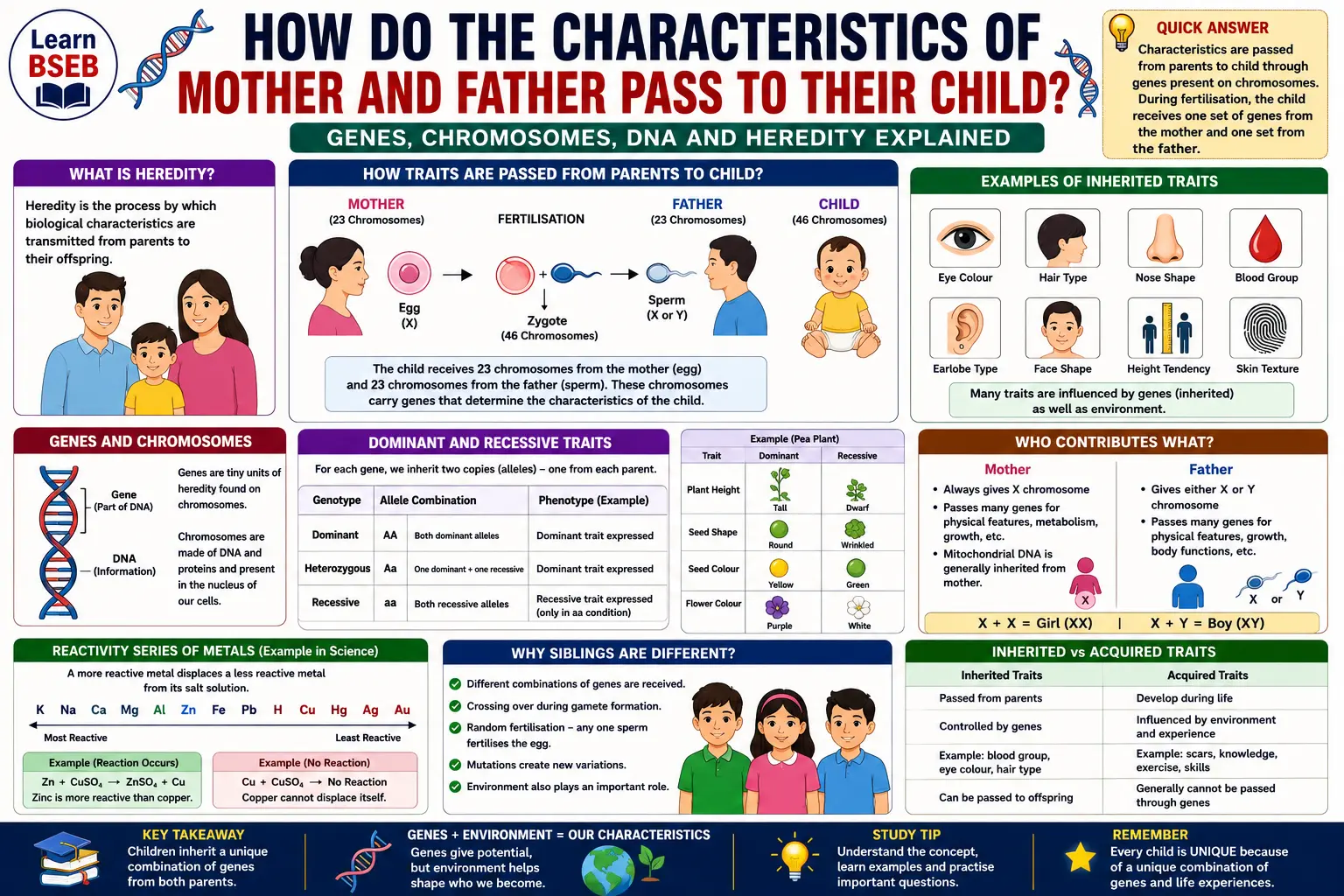
Children often resemble their mother, father or other family members. A child may have the eyes of the mother, the hair type of the father, the face shape of a grandparent or a combination of several family characteristics.
This raises an important Biology question:
How do the characteristics of the mother and father pass to their child?
The characteristics of parents are passed to their children through genes. Genes are small units of heredity present on chromosomes. Chromosomes are found inside the nucleus of most cells and are made mainly of DNA.
During reproduction, the mother and father each contribute genetic material to the child. A human child normally receives one set of chromosomes from the mother and one set from the father. These chromosomes carry thousands of genes that influence physical characteristics, bodily functions, and many other biological features.
However, a child is not an exact copy of either parent. The child receives a unique combination of genes from both parents. This is why brothers and sisters can look different even though they have the same parents.
Quick Answer
The characteristics of the mother and father are passed to their child through genes located on chromosomes.
During fertilisation:
- The mother contributes an egg cell.
- The father contributes a sperm cell.
- Each reproductive cell carries half the normal number of chromosomes.
- The egg and sperm fuse to form a zygote.
- The zygote receives one set of chromosomes from the mother and one set from the father.
- Genes present on these chromosomes influence the child’s inherited characteristics.
The child may inherit characteristics such as blood group, natural eye colour, hair texture and certain facial features. At the same time, environmental factors such as nutrition, education, exercise and lifestyle also influence how some characteristics develop.
What Are Characteristics?
A characteristic is a feature or quality of an organism.
In humans, characteristics may include:
- Eye colour
- Hair colour
- Hair texture
- Skin pigmentation
- Blood group
- Height tendency
- Shape of the nose
- Facial structure
- Earlobe type
- Natural body build
- Certain inherited health conditions
- Ability to digest particular substances
- Some aspects of metabolism
Characteristics can be divided into inherited and acquired characteristics.
Inherited Characteristics
Inherited characteristics are features passed from parents to children through genes.
Examples:
- Blood group
- Natural eye colour
- Natural hair type
- Certain facial features
- Some genetic conditions
Acquired Characteristics
Acquired characteristics develop during life because of the environment, learning, practice, disease, injury or lifestyle. They are generally not passed genetically to children.
Examples:
- Muscles developed through exercise
- A scar caused by an injury
- Ability to ride a bicycle
- Language learned at school
- Improved handwriting
- Knowledge acquired through study
This difference is important because not every characteristic of a parent is inherited by the child.
What Is Heredity?
Heredity is the process by which biological characteristics are passed from parents to offspring.
The study of heredity is called genetics.
Heredity explains why:
- Children resemble their parents.
- Members of a family may share similar facial features.
- Blood groups run in families.
- Certain inherited conditions appear in particular families.
- Offspring of the same species share basic characteristics.
For example, human parents produce human children because the genetic information passed to the child contains the instructions for human development.
What Are Genes?
Genes are the basic units of heredity.
A gene is a specific segment of DNA that contains information used by the body to make a functional product, often a protein or functional RNA.
Genes influence many biological characteristics by guiding:
- Protein production
- Cell function
- Growth
- Development
- Metabolism
- Body structure
- Pigment production
- Blood-group formation
Genes do not usually work like simple switches for every characteristic. A single gene strongly influences some traits, while many human characteristics are controlled by many genes working together.
Height, skin pigmentation and body build are examples of complex traits influenced by multiple genes and environmental factors.
What Is DNA?
DNA stands for Deoxyribonucleic Acid.
DNA is the hereditary material present in chromosomes. It stores biological instructions in a coded form.
The DNA molecule has a double-helix structure. Its information is written using four chemical bases:
- Adenine
- Thymine
- Guanine
- Cytosine
These bases are often represented by the letters:
A, T, G and C
The sequence of these bases forms genetic instructions.
A useful comparison is:
- DNA is like a complete instruction library.
- Chromosomes are like organised volumes.
- Genes are like individual instructions or sections within those volumes.
What Are Chromosomes?
Chromosomes are thread-like structures present inside the cell nucleus. They are made of DNA associated with proteins.
Humans normally have 46 chromosomes in most body cells. These are arranged in 23 pairs.
In each pair:
- One chromosome comes from the mother.
- One chromosome comes from the father.
Therefore, the child receives genetic information from both parents.
Human Chromosome Number
Cell Type | Chromosome Number |
Most body cells | 46 |
Egg cell | 23 |
Sperm cell | 23 |
Fertilised egg or zygote | 46 |
The egg and sperm each contain half the normal chromosome number. When they fuse during fertilisation, the normal chromosome number is restored.
How Do Mother and Father Pass Genes to a Child?
The process begins with the formation of reproductive cells.
The Mother Contributes an Egg
The egg cell is formed in the mother’s reproductive system.
A normal human egg carries:
- 23 chromosomes
- Thousands of genes
- One sex chromosome, which is always X
The Father Contributes a Sperm
The sperm cell is formed in the father’s reproductive system.
A normal sperm carries:
- 23 chromosomes
- Thousands of genes
- Either an X chromosome or a Y chromosome
Fertilisation
Fertilisation occurs when one sperm fuses with an egg.
The nuclei of the two cells combine:
23 chromosomes from mother + 23 chromosomes from father = 46 chromosomes
The new cell formed is called a zygote.
The zygote divides repeatedly and develops into an embryo and later a baby.
Every cell formed from the zygote receives genetic information copied from the original combination of maternal and paternal chromosomes.
Why does a child resemble both parents?
A child resembles both parents because the child receives genes from both.
For many genes, the child receives:
- One version from the mother
- One version from the father
These alternative forms of a gene are called alleles.
The combination of alleles influences how a characteristic appears.
For example, a gene involved in pigment production may have different variants. The child may receive one variant from the mother and another from the father. The final appearance depends on how those variants function together and on the involvement of other genes.
This is why a child may:
- Have the mother’s eye shape
- Have the father’s hair texture
- Resemble a grandparent
- Show a combination not exactly seen in either parent
Why Is a Child Not an Exact Copy of the Parents?
A child receives a new combination of genes.
Several processes create this uniqueness.
1. Random Formation of Egg and Sperm Cells
During the formation of reproductive cells, chromosome pairs separate. Each egg or sperm receives only one chromosome from each pair.
The combination received by each reproductive cell is largely random.
2. Crossing Over
During meiosis, paired chromosomes may exchange sections of DNA. This process is called crossing over.
It creates new combinations of genes.
3. Random Fertilisation
Millions of sperm may be produced, but usually only one fertilises the egg. The particular sperm and egg that combine determine the child’s unique genetic combination.
4. Mutation
A mutation is a change in DNA. Mutations may introduce new genetic variations.
Many mutations have no noticeable effect. Some are harmful, some may be beneficial, and others simply contribute to variation.
What Are Dominant and Recessive Traits?
In basic genetics, alleles are often described as dominant or recessive.
Dominant Allele
A dominant allele can influence a trait even when only one copy is present.
It is commonly represented by a capital letter.
Example:
B
Recessive Allele
A recessive allele usually shows its effect only when two copies are present.
It is commonly represented by a small letter.
Example:
b
Possible Combinations
Combination | Description |
BB | Two dominant alleles |
Bb | One dominant and one recessive allele |
bb | Two recessive alleles |
In a simple model, both BB and Bb may show the dominant characteristic, while bb shows the recessive characteristic.
However, human genetics is often more complex than simple dominant–recessive examples. Many traits involve multiple genes, incomplete dominance, codominance or environmental influence.
Genotype and Phenotype
Two important terms in genetics are genotype and phenotype.
Genotype
The genotype is the genetic combination an organism carries for a trait.
Examples:
- AA
- Aa
- aa
Phenotype
The phenotype is the observable characteristic produced by the genotype together with environmental influence.
Examples:
- A visible flower colour
- A particular blood-group type
- A measurable height
- A specific enzyme activity
Simple relationship:
Genotype + Environment → Phenotype
This means genes provide biological instructions, but the environment can influence how some traits develop.
Does a Child Receive Exactly 50% from Each Parent?
At the chromosome level, a child normally receives one set of 23 chromosomes from the mother and one set of 23 from the father.
Therefore, the child receives approximately half of the nuclear genetic material from each parent.
However, the expression “exactly 50% of every characteristic” is misleading.
A child does not receive:
- Half of the mother’s eye colour
- Half of the father’s nose
- Exactly half of every visible feature
Instead, the child receives different combinations of gene variants from each parent.
Also, mitochondrial DNA is generally inherited from the mother. Therefore, inheritance is not perfectly symmetrical in every type of genetic material.
How Is the Sex of a Child Determined?
Humans have sex chromosomes.
Females generally have:
XX
Males generally have:
XY
The mother’s egg always carries an X chromosome.
The father’s sperm may carry:
- X chromosome
- Y chromosome
Possible combinations:
Egg | Sperm | Usual Chromosome Pattern |
X | X | XX |
X | Y | XY |
Therefore, the sperm contributes either the X or Y chromosome, which usually determines the chromosomal sex of the child.
It is scientifically incorrect to blame the mother for whether the child is male or female.
Which Characteristics Are Inherited from the Mother?
A child may inherit many gene variants from the mother, including genes that influence:
- Eye pigmentation
- Hair characteristics
- Blood group
- Facial development
- Height potential
- Metabolism
- Immune-system function
The mother also generally passes mitochondrial DNA to the child. Mitochondria are structures that help cells release energy.
However, it is not correct to say that a particular broad feature always comes only from the mother. Most characteristics involve genes from both parents.
Which Characteristics Are Inherited from the Father?
The father also contributes thousands of genes that influence:
- Physical appearance
- Growth
- Blood group
- Hair and skin characteristics
- Metabolism
- Immune function
- Many body processes
The father contributes either an X or a Y chromosome through the sperm.
Again, most features are not exclusively “from the father” or “from the mother.” They result from the interaction of genes inherited from both.
Can a Child Resemble Grandparents?
Yes.
Parents carry gene variants inherited from their own parents. Some of these variants may not be clearly visible in the parents but may be passed to the child.
For example, a recessive allele may be carried by both parents without showing in either. If the child receives the recessive allele from both, the characteristic may appear.
This is why children may resemble:
- Grandparents
- Uncles or aunts
- Other relatives
- Earlier generations
Mendel and the Study of Heredity
Gregor Johann Mendel is often called the father of genetics.
He studied inheritance using pea plants.
Mendel selected traits such as:
- Tall and dwarf plants
- Round and wrinkled seeds
- Yellow and green seeds
- Purple and white flowers
His experiments helped establish basic principles of inheritance.
Mendel’s Main Ideas
Traits Are Controlled by Units
Mendel proposed that characteristics are controlled by separate hereditary units. These units are now called genes.
Hereditary Units Occur in Pairs
An organism receives one unit from each parent.
Alleles Separate During Gamete Formation
The two alleles separate when reproductive cells are formed.
One Allele May Dominate Another
In some cases, one allele masks the visible effect of another.
Mendel’s work provided the foundation of classical genetics.
Example of a Monohybrid Cross
Suppose:
- T represents a dominant allele
- .. t represents a recessive allele
A cross between two heterozygous individuals:
Tt × Tt
Each parent can produce two types of gametes:
- T
- t
Punnett square:
T | t | |
T | TT | Tt |
t | Tt | tt |
Possible genotypes:
- TT
- Tt
- Tt
- tt
Genotype ratio:
1 TT : 2 Tt : 1 tt
If T is completely dominant, the phenotype ratio is:
3 dominant: 1 recessive
This is a simplified model used to understand inheritance.
Blood Group Inheritance
The ABO blood-group system is a useful example of inheritance.
The main alleles are:
- IA
- IB
- i
IA and IB are codominant. Both are dominant over i.
Possible blood groups:
Genotype | Blood Group |
IAIA or IAi | A |
IBIB or IBi | B |
IAIB | AB |
ii | O |
A child’s possible blood group depends on the alleles inherited from both parents.
For example, if one parent has genotype IAi and the other has IBi, possible child blood groups include:
- A
- B
- AB
- O
Blood-group inheritance shows that characteristics can follow more complex patterns than simple dominance.
Are Eye Colour and Skin Colour Controlled by One Gene?
Usually not.
Many popular explanations incorrectly describe eye colour or skin colour as a single dominant–recessive trait. In reality, these characteristics are influenced by multiple genes.
Eye Colour
Eye colour is influenced by genes affecting the amount and distribution of melanin in the iris.
Multiple gene variants interact to produce a range of eye colours.
Skin Pigmentation
Skin pigmentation is a polygenic characteristic influenced by several genes involved in melanin production and distribution.
Sun exposure can also influence visible pigmentation.
Height
Height is influenced by many genes and by environmental factors such as:
- Nutrition
- Health
- Hormones
- Sleep
- Physical activity
Therefore, the inheritance of many human features cannot be predicted using a single Punnett square.
Role of the Environment
Genes do not act in isolation.
The environment affects how many characteristics develop.
Height Example
Genes influence height potential, but final height can also be affected by:
- Nutrition
- Childhood illness
- Hormone levels
- Sleep
- General health
Body Weight
Genes may influence metabolism and body composition, but diet, exercise and lifestyle are also important.
Intelligence and Learning
Genetic factors may influence aspects of brain development, but education, environment, nutrition, opportunity, motivation and experience play major roles.
Skin Appearance
Natural pigmentation has a genetic basis, but sun exposure and health can affect visible skin appearance.
Therefore:
Inherited potential is shaped by environmental conditions.
Inherited and Acquired Traits: Comparison
Inherited Traits | Acquired Traits |
Passed through genes | Develop during life |
Present because of heredity | Influenced by the environment or practice |
Can pass to offspring | Generally not genetically passed |
Example: blood group | Example: learned language |
Example: natural hair type | Example: muscle development |
Example: certain genetic disorders | Example: scar from injury |
Can Acquired Characteristics Be Inherited?
Normally, acquired characteristics are not passed through genes.
For example, if a parent develops strong muscles through exercise, the child does not automatically inherit those developed muscles.
Similarly:
- A scar is not inherited.
- Knowledge learned by a parent is not directly inherited genetically.
- A skill acquired through practice is not transferred through DNA.
Only changes affecting hereditary material in reproductive cells can potentially be passed to the next generation.
What Is Variation?
Variation refers to differences among individuals of the same species.
Examples in humans:
- Different heights
- Different facial structures
- Different hair textures
- Different skin pigmentation
- Different blood groups
Variation occurs because of:
- Different gene combinations
- Crossing over
- Random fertilisation
- Mutations
- Environmental influence
Variation is important because it increases diversity within a population.
Why Is Variation Important?
Variation helps populations survive changing environments.
If all individuals were genetically identical, a single disease or environmental change could affect everyone in the same way.
Genetic variation increases the chance that some individuals may be better able to survive:
- Climate change
- New diseases
- Food shortages
- Environmental stress
Variation also provides the raw material for evolution.
Heredity and Evolution
Heredity passes characteristics from one generation to the next.
Variation creates differences among offspring.
Over many generations, useful inherited variations may become more common through natural selection.
Therefore, heredity and variation together are central to evolution.
Simple sequence:
Heredity → Continuity of traits
Variation → Differences among individuals
Natural selection → Differential survival and reproduction
Evolution → Change in populations over generations
Do Parents Pass Diseases to Children?
Some diseases and conditions can have a genetic component.
Examples may include:
- Sickle-cell disease
- Thalassemia
- Haemophilia
- Certain types of colour-vision deficiency
- Some metabolic disorders
However, not every disease is inherited.
Diseases may be:
- Genetic
- Infectious
- Nutritional
- Lifestyle-related
- Environmental
- Multifactorial
A family history may increase the risk for some conditions, but it does not always mean the child will definitely develop the condition.
Medical genetic questions should be discussed with qualified healthcare professionals or genetic counsellors.
Autosomal and Sex-Linked Inheritance
Autosomal Inheritance
Autosomal genes are located on chromosomes other than X and Y.
A characteristic may be:
- Autosomal dominant
- Autosomal recessive
Sex-Linked Inheritance
Some genes are located on the X or Y chromosome.
X-linked conditions may show different inheritance patterns in males and females because:
- Females generally have two X chromosomes.
- Males generally have one X and one Y chromosome.
This helps explain inheritance patterns of some genetic conditions.
Why Do Siblings Look Different?
Brothers and sisters receive genes from the same parents, but they do not usually receive the same exact combination.
Each child results from:
- A different egg
- A different sperm
- A different combination of chromosomes
- Different crossing-over events
- Different environmental experiences
The probability of two non-identical siblings receiving the same complete genetic combination is extremely small.
Identical twins are an exception because they usually develop when one fertilised egg splits into two embryos.
Identical and Fraternal Twins
Identical Twins
Identical twins usually develop from one fertilised egg that divides into two embryos.
They have very similar nuclear DNA.
However, they may still show differences because of:
- Environment
- Development
- Epigenetic changes
- Life experiences
Fraternal Twins
Fraternal twins develop from two different eggs fertilised by two different sperm cells.
They are genetically similar to ordinary siblings and may look quite different.
What Is Epigenetics?
Epigenetics studies changes in gene activity that do not involve changes in the basic DNA sequence.
Chemical tags can influence whether certain genes are more or less active.
Epigenetic patterns can be affected by:
- Development
- Age
- Nutrition
- Environment
- Stress
- Disease
Epigenetics helps explain why individuals with very similar DNA can still show differences.
It does not mean that every acquired characteristic is directly inherited.
Simple Flow of Inheritance
The inheritance of parental characteristics can be understood through this sequence:
- Parents carry genes on chromosomes.
- Reproductive cells are formed through meiosis.
- Eggs and sperm receive half the chromosome number.
- Fertilisation combines maternal and paternal chromosomes.
- A zygote with 46 chromosomes is formed.
- The zygote divides and develops.
- Genes guide protein production and development.
- Genetic and environmental factors together shape the child’s characteristics.
Common Misconceptions
Misconception 1: Every Trait Comes Only from One Parent
Most characteristics are influenced by genes inherited from both parents.
Misconception 2: The Mother Determines the Sex of the Child
The mother’s egg always contributes an X chromosome. The father’s sperm contributes either X or Y.
Misconception 3: A Child Receives Exactly Half of Every Visible Feature
The child receives chromosomes from both parents, not exact physical halves of each feature.
Misconception 4: Dominant Means Better or Stronger
Dominant only describes how an allele is expressed. It does not mean healthier, superior or more common.
Misconception 5: Recessive Traits Are Weak
Recessive refers to expression in a particular allele combination. It does not mean the characteristic is biologically weak.
Misconception 6: All Human Traits Follow Simple Mendelian Ratios
Many human traits are polygenic or influenced by the environment.
Misconception 7: Skills Learned by Parents Are Passed Genetically
Learned skills are acquired and are not directly encoded into the child’s genes.
One-Mark Answer
Question: How do the characteristics of the mother and father pass to their child?
Answer: Characteristics pass from parents to their child through genes present on chromosomes. The child receives one set of chromosomes from the mother and one set from the father.
Two-Mark Answer
Question: Explain how parental characteristics are inherited by a child.
Answer: During fertilisation, the egg from the mother and sperm from the father combine. Each contributes 23 chromosomes carrying genes. The child therefore receives genetic information from both parents.
Three-Mark Answer
Question: Why does a child resemble both parents but is not identical to either?
Answer: A child receives one set of chromosomes from the mother and one set from the father. The genes from both parents interact to influence the child’s characteristics. During reproductive-cell formation and fertilisation, genes are recombined randomly, creating a unique genetic combination. Therefore, the child resembles both parents but is not an exact copy of either.
Five-Mark Answer
Question: Describe how characteristics are transmitted from parents to offspring.
Answer: Characteristics are transmitted through genes located on chromosomes. Human body cells normally contain 46 chromosomes arranged in 23 pairs. During the formation of reproductive cells, the chromosome number is reduced to 23. The mother’s egg and the father’s sperm each carry one set of chromosomes. During fertilisation, they combine to form a zygote with 46 chromosomes. The zygote therefore receives genes from both parents. These genes guide growth, development and many biological characteristics. Crossing over, random chromosome separation and random fertilisation create variation, so the child resembles the parents but is genetically unique.
Practice Questions
Question 1
What is heredity?
Answer: Heredity is the process by which biological characteristics are passed from parents to offspring.
Question 2
What is a gene?
Answer: A gene is a unit of heredity made of DNA that carries information influencing a biological characteristic or function.
Question 3
How many chromosomes does a human egg contain?
Answer: A human egg normally contains 23 chromosomes.
Question 4
How many chromosomes are present in a zygote?
Answer: A normal human zygote contains 46 chromosomes.
Question 5
Why do siblings differ from each other?
Answer: Siblings receive different combinations of genes because of random chromosome separation, crossing over and random fertilisation.
Question 6
What is the difference between inherited and acquired traits?
Answer: Inherited traits pass through genes, while acquired traits develop during life due to environment, learning or experience.
Question 7
Which parent determines the chromosomal sex of the child?
Answer: The father’s sperm contributes either an X or a Y chromosome and therefore usually determines the chromosomal sex.
Question 8
Can a scar be inherited?
Answer: No. A scar is an acquired characteristic and is not normally passed through genes.
Multiple-Choice Questions
1. The basic unit of heredity is:
- Tissue
B. Gene
C. Organ
D. Enzyme
Answer: B. Gene
2. Genes are located on:
- Ribosomes
B. Chromosomes
C. Cell walls
D. Vacuoles
Answer: B. Chromosomes
3. A normal human sperm contains:
- 46 chromosomes
B. 44 chromosomes
C. 23 chromosomes
D. 22 pairs
Answer: C. 23 chromosomes
4. The cell formed after fertilisation is called:
- Gamete
B. Zygote
C. Tissue
D. Allele
Answer: B. Zygote
5. Which is an acquired characteristic?
- Blood group
B. Natural eye colour
C. Scar from injury
D. Genetic disorder
Answer: C. Scar from injury
6. The mother normally contributes which sex chromosome?
- X only
B. Y only
C. X or Y
D. No sex chromosome
Answer: A. X only
7. Variation among siblings occurs mainly because:
- They have no genes
B. They receive different gene combinations
C. Only the mother contributes genes.
D. Chromosomes are absent
Answer: B. They receive different gene combinations
8. Which molecule stores hereditary information?
- Glucose
B. DNA
C. Starch
D. Water
Answer: B. DNA
Frequently Asked Questions
How do the characteristics of mother and father pass to a child?
They pass through genes present on chromosomes. The child receives chromosomes from both the mother’s egg and the father’s sperm.
Does a child receive more genes from the mother or the father?
A child normally receives one set of nuclear chromosomes from each parent. Mitochondrial DNA is generally inherited from the mother.
Why does a child look more like one parent?
Some visible gene combinations may resemble one parent more strongly, but the child still receives genetic material from both.
Can a child have a trait not visible in either parent?
Yes. Parents may carry recessive alleles that become visible when the child receives the relevant combination.
Do children inherit intelligence from their parents?
Cognitive abilities are complex and influenced by many genes as well as education, nutrition, environment, health and opportunity.
Is height inherited?
Height is strongly influenced by many genes, but nutrition, health and hormones also affect final height.
Who determines the sex of the child?
The father’s sperm usually determines whether the zygote receives an X or Y chromosome.
Are habits inherited?
Some biological tendencies may have genetic influences, but learned habits mainly develop through the environment and experience.
Why can siblings have different blood groups?
They may inherit different combinations of ABO blood-group alleles from the same parents.
Can acquired traits pass to children?
Acquired traits such as scars, exercise-developed muscles and learned skills are generally not genetically inherited.
What is the role of chromosomes in heredity?
Chromosomes carry DNA and genes from parents to offspring.
Why are children not identical to their parents?
Children receive a recombined and unique mixture of genetic material from both parents.
Can diseases be inherited?
Some conditions have genetic causes or inherited risk factors, while many diseases are caused by infection, environment or lifestyle.
What is the difference between genotype and phenotype?
Genotype is the genetic makeup, while phenotype is the observable result of genes and environmental influence.
Do grandparents’ traits pass to grandchildren?
Yes. Parents can carry gene variants inherited from grandparents and pass them to their children.
Conclusion
The characteristics of a mother and father pass to their child through genes, DNA and chromosomes.
The mother contributes an egg containing 23 chromosomes, while the father contributes a sperm containing 23 chromosomes. During fertilisation, the egg and sperm combine to form a zygote with 46 chromosomes.
The child therefore receives:
- One set of chromosomes from the mother
- One set of chromosomes from the father
- Thousands of gene variants from both parents
These genes influence characteristics such as blood group, natural hair type, eye pigmentation, body development and many cellular functions.
However, the child is not an exact copy of either parent. Meiosis, crossing over, random chromosome distribution and random fertilisation create a unique combination of genes. Environmental factors such as nutrition, education, health and lifestyle also influence how many characteristics develop.
The most important idea is:
Parents pass genetic information to their children through genes, but each child receives a unique combination of genes and therefore shows both family resemblance and individual variation.