
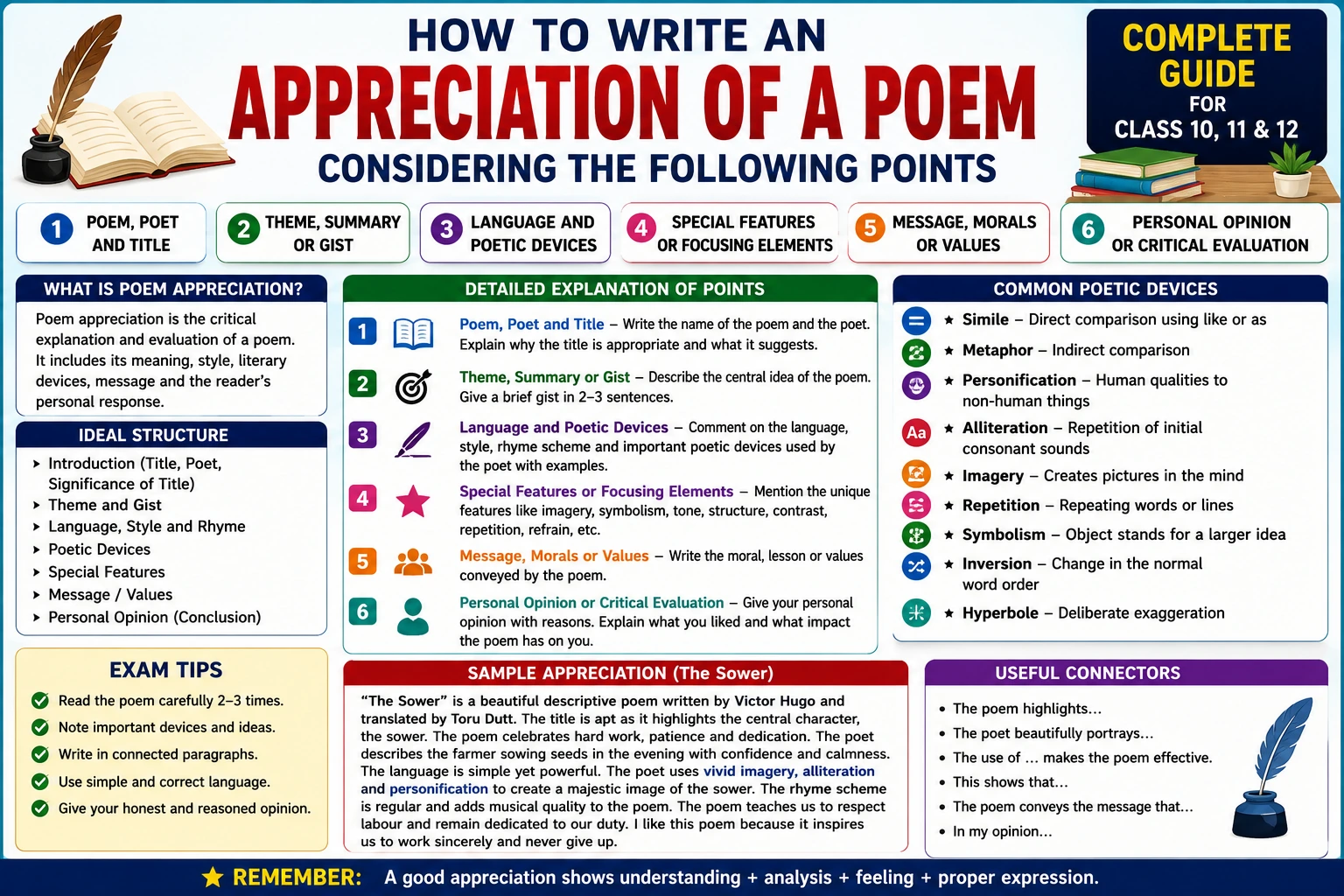
The instruction “Write an appreciation of the poem considering the following points” is commonly asked in school and board examinations. Many students understand the poem but lose marks because they do not know how to organise their appreciation.
A poetic appreciation is not merely a summary. It is a short, well-structured evaluation of the poem. It explains what the poem is about, how the poet presents the idea, which poetic devices make it effective, what message it communicates and what the student personally thinks about it.
Maharashtra Board textbooks commonly ask students to cover the poem, poet and title; theme or gist; language and poetic devices; special features; message or values; and personal opinion. The HSC question-bank format also includes the significance of the title, poetic form, style, inspirational message and critical evaluation.
This article provides a complete student-friendly method, ready-to-use format, useful vocabulary, common poetic devices, sample appreciation and exam-writing tips.
Quick Answer for AI Overview
To write an appreciation of a poem, begin with the title, poet and type of poem. Then explain its central theme or gist, followed by its language, rhyme scheme, poetic devices and special features. Mention the message or values conveyed by the poem and end with your personal opinion. Write in connected paragraphs rather than answering each point separately unless the question specifically asks for a table.
Poem Appreciation at a Glance
Point | What to Write |
Title and poet | Name of the poem and poet |
Significance of title | Why the title is suitable |
Type or form | Sonnet, lyric, ballad, free verse, narrative poem, etc. |
Theme | Main idea of the poem |
Summary or gist | Brief explanation of what happens |
Language | Simple, musical, descriptive, symbolic or conversational |
Poetic devices | Simile, metaphor, imagery, personification, alliteration, etc. |
Rhyme scheme | Pattern such as abab, aabb or free verse |
Special features | Imagery, structure, tone, refrain, contrast or symbolism |
Message | Moral, value or lesson |
Personal opinion | What you liked and why |
What Does “Appreciation of a Poem” Mean?
Poem appreciation means understanding and evaluating a poem as a work of literature.
The word appreciation does not mean that the student must only praise the poem. It means recognising:
- the poem’s meaning;
- the poet’s purpose;
- the beauty of its language;
- the techniques used by the poet;
- the effect created on the reader;
- the values or message conveyed.
A good appreciation shows that the student has understood both what the poet says and how the poet says it.
Simple Definition
Poetic appreciation is a brief critical explanation of a poem’s theme, style, language, poetic devices, message and overall effect.
Student-Friendly Definition
A poem appreciation explains the poem’s idea, beauty, writing style and message, followed by the reader’s opinion.
Why Is Poem Appreciation Important?
Poetry often communicates more than the literal meaning of its words. A poet may use imagery, symbols, comparisons, sound effects and unusual word order to express an idea.
Writing an appreciation helps students:
- understand the central idea;
- identify poetic devices;
- recognise the poet’s tone;
- explain the significance of the title;
- connect the poem with real life;
- develop independent literary judgment;
- improve analytical writing.
It also tests whether the student can organise several observations into a clear and meaningful answer.
Official Points Commonly Given for Poem Appreciation
The exact wording may differ from one question paper to another. However, the commonly prescribed points include:
- About the poem, poet and title
- Theme, summary or gist
- Poetic style and language
- Poetic devices
- Special features or focusing elements
- Message, values or morals
- Personal opinion
These points appear repeatedly in Maharashtra State Board textbook exercises.
HSC-style appreciation questions may combine them under broader headings such as:
- significance of the title;
- form and theme;
- language and poetic devices;
- inspirational message and values;
- personal opinion and critical evaluation.
Difference Between Poem Appreciation and Summary
Students often write only the story or meaning of the poem. That becomes a summary, not an appreciation.
Poem Summary | Poem Appreciation |
Explains what the poem says | Explains meaning and literary beauty |
Focuses on events or ideas | Focuses on theme, style and effect |
Usually avoids detailed devices | Includes poetic devices |
Personal opinion is not essential | Personal opinion is important |
Mainly answers “What happens?” | Answers “What, how and why?” |
Does not always mention rhyme | May mention form and rhyme scheme |
Retells content | Evaluates the poem |
Example
A summary may say:
The poem describes a farmer sowing seeds in the evening.
An appreciation adds:
The poet presents the farmer as a majestic and dedicated figure through visual imagery, alliteration and comparison with the starry sky.
How to Write an Appreciation of the Poem Step by Step
Step 1: Read the Poem Carefully
Read the poem at least twice.
During the first reading, understand its general meaning. During the second reading, mark:
- repeated words;
- comparisons;
- images;
- rhyming words;
- emotional expressions;
- important symbols;
- changes in tone;
- unusual sentence structures.
Do not begin writing immediately after reading only the first stanza.
Questions to Ask While Reading
- Who is speaking?
- What is being described?
- What emotion dominates the poem?
- Is there a story or argument?
- Does the poem change from sadness to hope?
- Which words or images are repeated?
- What lesson does the poem suggest?
Step 2: Mention the Poem, Poet and Title
Begin by naming the poem and the poet.
A safe opening is:
“_____” is a meaningful poem written by _____.
Then state what the poem broadly deals with.
Example
“The Sower” is a narrative and descriptive poem associated with Victor Hugo and translated into English by Toru Dutt. It presents the dedication and dignity of a solitary farmer.
Explain the Significance of the Title
Do not merely repeat the title. Explain why it is suitable.
Use questions such as:
- Does the title identify the central character?
- Does it indicate the main symbol?
- Does it introduce the central conflict?
- Does its meaning become clearer after reading the poem?
- Is the title literal or symbolic?
Useful Sentences
- The title is appropriate because it highlights the central idea of the poem.
- The title refers directly to the poem’s main character.
- The title is symbolic and becomes meaningful in the final stanza.
- The title prepares the reader for the poem’s central theme.
- The title is brief, striking and relevant.
Step 3: Identify the Type or Form of the Poem
Mention the form only when you are reasonably certain.
A poem may be:
- a lyric;
- a sonnet;
- a ballad;
- a narrative poem;
- a nature poem;
- an ode;
- an elegy;
- a dramatic monologue;
- a reflective poem;
- a free-verse poem.
Examples
The poem is a lyrical expression of hope and confidence.
It is a narrative poem because it presents events in a sequence.
It is written in free verse and does not follow a regular rhyme scheme.
It is a sonnet consisting of fourteen lines.
Do not call every poem a lyric or sonnet without checking its structure.
Step 4: Explain the Theme
The theme is the main idea explored by the poem.
It is not always the same as the subject.
Subject Versus Theme
Subject | Theme |
A farmer | Dignity of labour |
A journey | Freedom and self-discovery |
Money | Wealth cannot guarantee happiness |
Weaving | Human life from birth to death |
Nature | Beauty, healing or environmental responsibility |
A father’s journey | Loneliness and alienation |
A river | Continuity, memory or cultural identity |
How to Find the Theme
Ask:
- What does the poet want the reader to understand?
- What idea continues throughout the poem?
- What does the ending reveal?
- Which human value is emphasised?
- What conflict is explored?
Useful Theme Sentences
- The central theme of the poem is the dignity of labour.
- The poem explores the conflict between material wealth and inner happiness.
- The poem celebrates freedom, confidence and independent living.
- The poet highlights loneliness within modern family life.
- The poem presents nature as a source of peace and inspiration.
- The poem shows that kindness and good deeds give meaning to life.
Step 5: Give a Brief Gist
After stating the theme, explain the poem in two or three sentences.
Do not narrate every line. Select only the details necessary to support the central idea.
Weak Gist
First this happens. Then that happens. After that another thing happens.
Better Gist
The poem presents a solitary farmer continuing his work after sunset. His confidence, patience and dedication gradually make him appear majestic in the poet’s imagination.
The gist should remain brief because the appreciation must also cover language, devices, message and personal response.
Step 6: Comment on Language and Style
The language may be:
- simple;
- conversational;
- musical;
- descriptive;
- symbolic;
- emotional;
- reflective;
- satirical;
- dramatic;
- formal;
- direct;
- figurative.
Questions to Consider
- Are the words easy or complex?
- Does the poem sound like natural speech?
- Does it create strong pictures?
- Does the poet use symbols?
- Is the tone humorous, serious or sad?
- Are the lines short and forceful?
- Does the poem use questions or repetition?
Ready-to-Use Sentences
- The language of the poem is simple, clear and effective.
- The poet uses vivid descriptive language to create visual images.
- The conversational style makes the poem easy to understand.
- The symbolic language gives the poem a deeper meaning.
- The short lines create urgency and emotional intensity.
- The musical quality of the poem is created through rhyme and repetition.
- The poet combines simplicity of expression with depth of thought.
Step 7: Mention the Rhyme Scheme
The rhyme scheme is the pattern created by end rhymes.
How to Find It
Look at the last word of each line.
Example:
light — A
way — B
bright — A
day — B
The rhyme scheme is abab.
Common Rhyme Schemes
- aabb
- abab
- abba
- abcabc
- no regular rhyme scheme
Safe Sentence for Free Verse
The poem is written in free verse and does not follow a fixed rhyme scheme.
Do not invent a rhyme scheme when only an extract is given. Mention the pattern visible in the given stanza or extract.
Step 8: Identify and Explain Poetic Devices
Naming a device is not enough. Explain how it works in the poem.
Weak Answer
The poem uses simile, metaphor and alliteration.
Better Answer
The poet uses simile to compare the city’s beauty with a garment, while personification makes the city appear like a living being. Alliteration adds musical effect through repeated consonant sounds.
Important Poetic Devices
Device | Meaning |
Simile | Direct comparison using “like” or “as” |
Metaphor | Indirect comparison |
Personification | Giving human qualities to non-human things |
Alliteration | Repetition of initial consonant sounds |
Repetition | Reusing words or expressions for emphasis |
Imagery | Language that creates sensory pictures |
Symbolism | An object represents a deeper idea |
Antithesis | Contrasting ideas placed together |
Inversion | Unusual order of words |
Hyperbole | Deliberate exaggeration |
Onomatopoeia | Words imitate sounds |
Apostrophe | Direct address to an absent person or object |
Pun | Wordplay based on double meanings |
Oxymoron | Apparently contradictory words together |
Paradox | A seemingly contradictory statement containing truth |
Refrain | A repeated line or group of lines |
Climax | Ideas arranged in increasing importance |
Enjambment | A sentence continues into the next line |
How Many Devices Should You Mention?
For a short answer, two to four important devices are usually enough.
Choose devices that genuinely influence the poem. Avoid listing ten devices without examples or explanation.
Step 9: Explain the Special Features
Special features are the qualities that make the poem memorable or different.
These may include:
- unusual title;
- powerful imagery;
- strong contrast;
- dramatic ending;
- repeated refrain;
- narrative development;
- striking symbol;
- emotional simplicity;
- conversational dialogue;
- effective use of nature;
- change in tone;
- unexpected conclusion;
- social relevance;
- universal theme.
Examples
The most striking feature of the poem is its use of three different times of day to represent the stages of human life.
The poem’s special feature is the gradual transformation of an ordinary worker into a majestic symbolic figure.
The unexpected ending gives the poem emotional power.
The use of questions directly involves the reader in the poem’s moral reflection.
Step 10: State the Message or Values
A poem’s message should arise naturally from its theme.
Possible values include:
- hard work;
- perseverance;
- kindness;
- freedom;
- self-confidence;
- respect for nature;
- dignity of labour;
- family affection;
- social responsibility;
- humility;
- courage;
- equality;
- hope.
Useful Sentences
- The poem teaches us to remain dedicated to our work.
- It conveys that wealth cannot replace genuine friendship.
- It inspires readers to help others and live meaningfully.
- The poem reminds us to respect nature.
- It teaches that courage and hope can overcome difficulties.
- The poet encourages us to value human relationships over material success.
Do not write a message unrelated to the poem.
Step 11: Add Your Personal Opinion
Personal opinion is an important part of appreciation.
Avoid vague endings such as:
I like this poem very much.
Explain what you liked and why.
Better Opinion Sentences
- I like the poem because its simple language communicates a profound message.
- The poem appeals to me because its imagery makes the scene vivid.
- I find the poem inspiring because it celebrates hard work and perseverance.
- The realistic presentation of loneliness makes the poem emotionally moving.
- I appreciate the poem’s unexpected ending and universal message.
- The poem remains relevant because its social concern applies to modern life.
Your opinion should be connected with a real feature of the poem.
Ideal Structure of a Poem Appreciation
A complete appreciation can be organised into three paragraphs.
Paragraph 1: Introduction and Theme
Include:
- title;
- poet;
- type or form;
- significance of title;
- theme and brief gist.
Paragraph 2: Literary Features
Include:
- language;
- style;
- rhyme scheme;
- important poetic devices;
- imagery, symbolism or structure;
- special features.
Paragraph 3: Message and Opinion
Include:
- values or lesson;
- relevance;
- personal opinion;
- concluding statement.
Recommended Answer Flow
Title and poet → Theme → Gist → Language → Rhyme scheme → Poetic devices → Special feature → Message → Personal opinion
Ready-to-Use Poem Appreciation Template
Use the following format by replacing the bracketed portions.
“[Title]” is a meaningful [type of poem] written by [poet’s name]. The title is suitable because [significance of title]. The poem deals with [main theme] and presents [brief gist].
The language of the poem is [simple/descriptive/symbolic/conversational]. It follows the rhyme scheme [rhyme scheme] or is written in free verse. The poet effectively uses [device 1], [device 2] and [device 3] to [effect of devices]. The most striking feature of the poem is [special feature].
The poem conveys the message that [message or value]. I like the poem because [reasoned personal opinion]. Its [language/imagery/message/ending] makes it memorable and relevant.
Short Template for Limited Time
“[Title]” by [poet] is a [type] poem about [theme]. Its title is appropriate because [reason]. The poet uses [language/style] and devices such as [devices] to present [main idea]. The rhyme scheme is [scheme/free verse]. The poem’s special feature is [feature]. It teaches us [message]. I like it because [opinion].
Point-Wise Template
Appreciation Point | Your Answer |
Title | |
Poet | |
Significance of title | |
Form | |
Theme | |
Gist | |
Language | |
Rhyme scheme | |
Poetic devices | |
Special feature | |
Message | |
Personal opinion |
Model Appreciation of “The Sower”
“The Sower” is a descriptive poem based on Victor Hugo’s French poem and translated into English by Toru Dutt. Its title is appropriate because the solitary sower is the central figure. The poem celebrates hard work, perseverance and the dignity of labour. The poet observes an old farmer sowing seeds even after daylight has begun to fade. His dedication gradually makes him appear majestic and larger than life.
The poem uses simple but highly visual language. Its regular rhyme pattern, alliteration, personification and striking imagery create a musical and picturesque effect. The growing silhouette of the sower and the image of seeds appearing like stars are especially memorable. The official textbook exercise also identifies hard work, perseverance, dedication and the sower’s majestic appearance as major focusing elements.
The poem teaches that sincere work gives dignity to an ordinary person. I like it because it turns a simple agricultural activity into an inspiring tribute to dedication and confidence.
Why This Model Works
It covers:
- poem and poet;
- significance of title;
- theme;
- brief gist;
- language;
- poetic devices;
- special imagery;
- message;
- personal opinion.
It does not retell every line of the poem.
Original Practice Example
Read this short original poem:
A little lamp beside the door
Still shines when storms begin to roar;
Though winds may test its fragile flame,
It guards the path and stays the same.
Sample Appreciation
“The Little Lamp” is a short inspirational poem about courage and constancy. The title is appropriate because the lamp is both the central object and a symbol of hope. The poem describes a small lamp that continues to shine despite a violent storm.
The language is simple, visual and musical. The rhyme scheme is aabb. Personification is used because the lamp appears to guard the path, while the storm symbolises hardship. The contrast between the fragile flame and the powerful wind highlights inner strength. Alliteration and imagery add to the poem’s musical and visual effect.
The poem teaches that true courage does not depend on physical size or power. I like it because it expresses an inspiring message through a clear and memorable image.
Appreciation of a Poem in 100–150 Words
When a word limit is given, do not write separate long paragraphs for every point. Combine related ideas.
Suggested Word Distribution
Section | Approximate Words |
Poem, poet, title and theme | 30–40 |
Style, rhyme and devices | 40–50 |
Special feature | 15–20 |
Message and opinion | 25–35 |
Compact Formula
Introduction: 2 sentences
Theme and gist: 2 sentences
Style and devices: 3 sentences
Message and opinion: 2 sentences
Useful Vocabulary for Poem Appreciation
Words to Describe a Poem
- inspiring;
- reflective;
- emotional;
- humorous;
- satirical;
- philosophical;
- descriptive;
- lyrical;
- narrative;
- symbolic;
- thought-provoking;
- motivational;
- realistic;
- imaginative;
- melodious;
- moving.
Words to Describe Language
- simple;
- lucid;
- clear;
- conversational;
- figurative;
- musical;
- expressive;
- vivid;
- elegant;
- powerful;
- direct;
- symbolic;
- picturesque.
Words to Describe Tone
- joyful;
- hopeful;
- optimistic;
- serious;
- melancholic;
- nostalgic;
- humorous;
- sarcastic;
- admiring;
- critical;
- compassionate;
- reflective;
- solemn;
- inspiring.
Words to Describe Effect
- creates a vivid picture;
- adds musical quality;
- strengthens the central idea;
- emphasises the contrast;
- creates emotional impact;
- makes the poem memorable;
- involves the reader;
- gives symbolic depth;
- highlights the poet’s concern;
- reinforces the message.
How to Write About Poetic Devices Professionally
Simile
Weak:
Simile is used.
Better:
The poet uses a simile to compare the subject with a familiar natural image, making the description vivid and easy to imagine.
Metaphor
The central metaphor gives an abstract idea a concrete and memorable form.
Personification
Personification brings the natural object to life and strengthens its emotional connection with the reader.
Alliteration
The repetition of the consonant sound creates rhythm and draws attention to the expression.
Imagery
Visual imagery enables readers to picture the scene clearly.
Repetition
Repetition emphasises the central thought and gives the lines a chant-like quality.
Antithesis
Contrasting ideas are placed together to highlight the difference between the two conditions.
Inversion
The normal word order is changed to give emphasis and maintain the poetic rhythm.
Symbolism
The object functions as a symbol of a larger human or spiritual idea.
How to Find the Tone of a Poem
Tone is the poet’s attitude towards the subject.
Ask:
- Is the poet praising someone?
- Is the poet angry about injustice?
- Is the poet remembering the past?
- Is the poet making fun of human behaviour?
- Is the poet giving advice?
- Is the poet expressing grief or hope?
Tone Examples
Situation | Possible Tone |
Praise of a worker | Admiring |
Death or loss | Sorrowful or elegiac |
Social injustice | Critical or angry |
Childhood memory | Nostalgic |
Freedom and travel | Optimistic |
Human foolishness | Humorous or satirical |
Spiritual reflection | Philosophical |
Natural beauty | Joyful or appreciative |
A poem may have more than one tone. Mention the main tone or explain the change.
How to Identify the Special Feature of a Poem
Students often repeat the theme under the heading “special feature.” These two points are different.
The theme is what the poem is about. The special feature is what makes its presentation distinctive.
Example
Theme:
The stages of human life.
Special feature:
The stages are represented through garments woven at different times of day.
Another example:
Theme:
Dedication of a farmer.
Special feature:
The farmer’s shadow grows symbolically until it appears to touch the sky.
Common Mistakes in Poem Appreciation
Writing Only the Summary
The appreciation must include language, devices, message and opinion.
Copying the Question Points as Headings Without Explanation
A connected answer usually reads more professionally.
Naming Devices Without Examples or Effects
Explain what each device contributes.
Inventing the Rhyme Scheme
Check the end words carefully.
Giving the Wrong Poet’s Name
Learn poem titles and poets together.
Writing an Unrelated Moral
The message must arise from the poem.
Using Empty Personal Opinion
Replace “I like it very much” with a specific reason.
Quoting Too Many Lines
An appreciation is an evaluation, not a reproduction of the poem.
Using Overly Complicated English
Clear sentences score better than incorrect decorative language.
Confusing Poet and Speaker
The speaking voice inside the poem is not always identical to the real poet.
Ignoring the Title
The significance of the title is frequently an assessment point.
Writing an Extremely Long Answer
Follow the word or sentence limit printed in the question paper.
Exam-Writing Strategy
Before Writing
Spend one or two minutes noting:
- title;
- poet;
- theme;
- two devices;
- rhyme scheme;
- message;
- opinion.
While Writing
- begin directly;
- use complete sentences;
- maintain paragraph flow;
- underline the title and key devices where permitted;
- use correct literary terms;
- avoid repetition;
- remain within the required length.
After Writing
Check:
- Have you named the poet?
- Have you stated the theme?
- Have you explained at least two poetic features?
- Have you mentioned the message?
- Have you included your opinion?
- Is the rhyme scheme correct?
- Are spelling and punctuation acceptable?
Poem Appreciation Checklist
Before submitting your answer, confirm that it includes:
- Title of the poem
- Name of the poet
- Significance of title
- Poetic form
- Central theme
- Brief gist
- Language and style
- Rhyme scheme
- Poetic devices
- Special feature
- Message or values
- Personal opinion
Frequently Asked Questions
What does “write an appreciation of the poem considering the following points” mean?
It means evaluating the poem by discussing its title, poet, theme, language, poetic devices, special features, message and personal response.
Is poem appreciation the same as summary?
No. A summary explains the content, while an appreciation also evaluates style, form, devices, message and effect.
How should I begin a poem appreciation?
Begin with:
“[Title]” is a meaningful [type of poem] written by [poet].
Then explain the theme and significance of the title.
How many paragraphs should I write?
Three compact paragraphs are ideal: introduction and theme, literary features, followed by message and opinion.
How many words should a poem appreciation contain?
Follow the limit given in the question. When no limit is stated, write a concise but complete response covering every prescribed point.
Should I write the points separately?
You may use a table when specifically required, but a connected paragraph answer usually appears more natural and professional.
Is rhyme scheme compulsory?
Mention it when it can be identified from the complete poem or extract. For free verse, state that there is no fixed rhyme scheme.
How many poetic devices should be included?
Two to four major devices with brief explanations are generally more useful than a long unexplained list.
What should I write under special features?
Mention the unusual technique that makes the poem memorable, such as powerful imagery, symbolism, narrative structure, refrain, contrast or an unexpected ending.
What should I write in personal opinion?
Explain what you found effective and why. Refer to the message, imagery, style, emotion or relevance of the poem.
Can I use the first person?
Yes. Expressions such as “I like the poem because…” are appropriate in the personal-response section.
Should I write the whole story of the poem?
No. Include only a brief gist and use the remaining space for literary evaluation.
What is the best ending?
A strong ending connects your opinion with the poem’s value:
I find the poem memorable because its simple language communicates a universal and inspiring message.
Ready-to-Memorise Universal Answer Format
“[Title]” is a meaningful poem written by [poet]. The title is appropriate because it reflects the central idea of the poem. The poem deals with [theme] and presents [brief gist].
The poet uses simple, expressive and effective language. The poem follows the rhyme scheme [scheme] or is written in free verse. Poetic devices such as [devices] add beauty, rhythm and depth to the poem. Its most striking feature is [special feature].
The poem conveys the message that [message]. I like the poem because its [language/imagery/message/ending] is impressive and relevant to human life.
Quick Revision Formula
Title + Poet + Theme + Gist + Style + Devices + Special Feature + Message + Opinion
Conclusion
The instruction “write an appreciation of the poem considering the following points” requires more than a retelling of the poem. A complete answer must show understanding of both content and craftsmanship.
Begin with the title, poet and central theme. Add a short gist, then discuss language, form, rhyme scheme and important poetic devices. Identify the poem’s special feature and explain its message. End with a thoughtful personal opinion.
The most effective appreciation is not necessarily the longest one. It is the answer that covers every required point clearly, uses correct literary terminology and explains how the poet’s techniques strengthen the poem’s meaning.
With regular practice, students can use the same basic structure for almost any poem while changing the theme, devices, features and message according to the given text.