
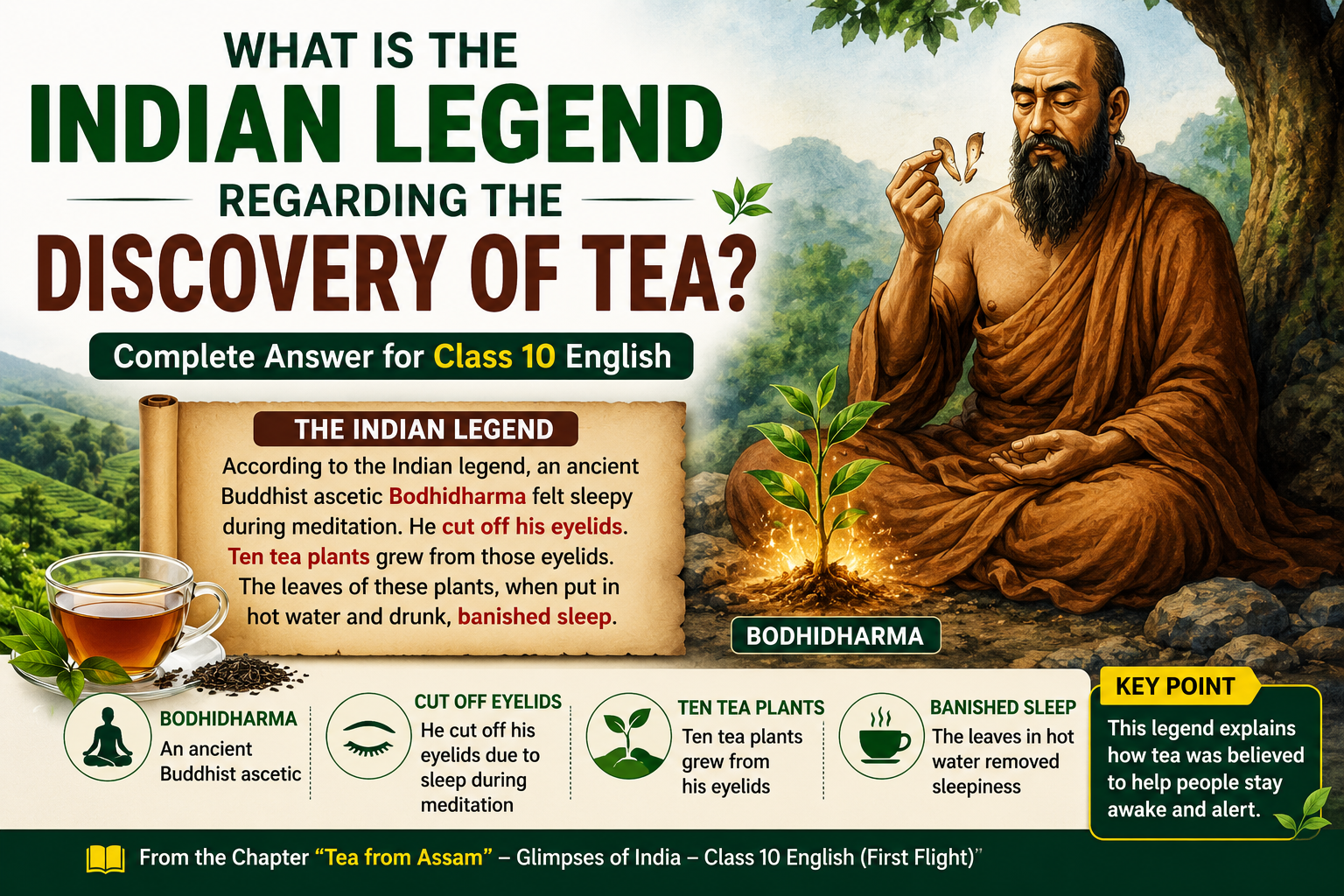
The Indian legend regarding the discovery of tea is connected with Bodhidharma, an ancient Buddhist ascetic. According to the legend, Bodhidharma once felt sleepy while meditating. He became so disappointed with himself that he cut off his eyelids. Ten tea plants are believed to have grown from those eyelids. When the leaves of these plants were placed in hot water and drunk, they helped people remain awake by driving away sleep.
This popular question comes from “Tea from Assam,” the third part of the chapter “Glimpses of India” in the Class 10 English textbook First Flight. In the story, Rajvir tells Pranjol about different legends connected with the discovery of tea while they are travelling through Assam. The official NCERT text describes both a Chinese legend and an Indian legend about tea.
Quick Answer: According to the Indian legend, the Buddhist ascetic Bodhidharma cut off his eyelids because he had fallen asleep during meditation. Ten tea plants grew from the eyelids. Their leaves, when boiled in water and drunk, helped people stay awake.
What Is the Indian Legend Regarding the Discovery of Tea?
The Indian legend says that an ancient Buddhist ascetic named Bodhidharma was deeply devoted to meditation. One day, however, he felt sleepy while meditating. He considered sleep an interruption to his spiritual discipline.
According to the legend, Bodhidharma cut off his eyelids so that he would never fall asleep during meditation again. Ten tea plants then grew from the place where his eyelids fell. People discovered that the leaves of these plants could be added to hot water to prepare a drink. When they drank it, the drink removed sleepiness and helped them remain alert.
The NCERT chapter presents this as a legend, not as a scientifically established account of how tea was actually discovered. Rajvir also says that nobody truly knows who discovered tea because several stories and legends are associated with its origin.
Direct Answer for Students
According to the Indian legend, Bodhidharma, an ancient Buddhist ascetic, cut off his eyelids because he felt sleepy during meditation. Ten tea plants grew out of the eyelids. The leaves of these plants, when put in hot water and drunk, banished sleep.
Simple Explanation of the Indian Tea Legend
The legend attempts to explain why tea helps people feel active and awake.
Bodhidharma wanted to meditate without sleeping. When he failed to control his sleep, he cut off his eyelids. Tea plants grew from them. As eyelids are connected with sleep, the story symbolically connects tea leaves with wakefulness.
The drink prepared from those leaves was believed to remove tiredness and sleepiness. Therefore, tea became associated with alertness, concentration and long periods of meditation.
Why Did Bodhidharma Cut Off His Eyelids?
According to the story, Bodhidharma cut off his eyelids because he felt sleepy during meditation.
He was an ascetic who valued discipline and concentration. He believed that sleep had disturbed his meditation. His extreme action in the legend represents his determination to remain awake and continue his spiritual practice.
Students should remember that this is part of a traditional story. It should not be interpreted as advice or as a real action that anyone should follow.
Key Point to Remember
The most important sequence is:
Bodhidharma felt sleepy → he cut off his eyelids → ten tea plants grew → their leaves were boiled in water → the drink removed sleep.
Indian Legend of Tea Discovery in Hindi
भारतीय किंवदंती के अनुसार बोधिधर्म नामक एक प्राचीन बौद्ध तपस्वी ध्यान करते समय सो गया था। ध्यान के दौरान नींद आने से वह बहुत निराश हुआ और उसने अपनी पलकों को काटकर फेंक दिया।
किंवदंती के अनुसार उन पलकों से चाय के दस पौधे उग आए। इन पौधों की पत्तियों को गर्म पानी में डालकर पीने से नींद दूर हो जाती थी और व्यक्ति जागा रहता था।
प्रश्न का हिंदी अर्थ
What is the Indian legend regarding the discovery of tea?
इसका हिंदी अर्थ है:
चाय की खोज के संबंध में भारतीय किंवदंती क्या है?
आसान हिंदी उत्तर
भारतीय किंवदंती के अनुसार बोधिधर्म नामक एक बौद्ध तपस्वी ध्यान करते समय सो गया था। उसने नींद से बचने के लिए अपनी पलकों को काट दिया। उन पलकों से चाय के दस पौधे उग आए। उन पौधों की पत्तियों को गर्म पानी में डालकर पीने से नींद दूर हो जाती थी।
Context of the Question in “Tea from Assam”
The question appears in the context of Rajvir and Pranjol’s journey to Assam.
Pranjol is from Assam, while Rajvir is his classmate in Delhi. Pranjol’s father manages a tea garden in Upper Assam. During the summer vacation, Pranjol invites Rajvir to visit his home.
While travelling by train, Rajvir observes the beautiful green landscape of Assam. Paddy fields slowly give way to rows of tea bushes. Rajvir is excited because he has never seen such a large tea-growing region before.
Pranjol, who has grown up around tea plantations, is not as surprised. For him, tea gardens are a familiar part of everyday life.
Rajvir tells Pranjol that he has read a great deal about tea. He explains that no one knows exactly who discovered tea, but several legends are connected with its discovery. He first narrates the Chinese legend and then the Indian legend involving Bodhidharma.
Who Narrates the Indian Legend?
Rajvir narrates the Indian legend to Pranjol.
This detail is important because students sometimes incorrectly write that Pranjol narrates the story. Pranjol asks Rajvir to tell him another legend, and Rajvir responds by describing the story of Bodhidharma.
Where Are Rajvir and Pranjol During This Conversation?
They are travelling by train towards Assam.
They are surrounded by passengers drinking tea. As the train moves into the tea-growing region, Rajvir begins discussing tea, tea gardens and the legends related to its discovery.
Why Does Rajvir Know About the Legend?
Rajvir tells Pranjol that he has been reading as much as possible about tea.
His knowledge of the legends shows that he is curious, observant and interested in learning about the place he is visiting. Later, Pranjol’s father is also surprised by Rajvir’s knowledge of tea cultivation.
Detailed Explanation of the Bodhidharma Tea Legend
The Indian legend is short, but it contains several meaningful ideas.
Bodhidharma as an Ancient Buddhist Ascetic
In the lesson, Bodhidharma is described as an ancient Buddhist ascetic.
An ascetic is a person who follows a highly disciplined life and gives up ordinary comforts to concentrate on spiritual goals. Such a person may spend long periods in prayer, meditation or self-discipline.
Within the legend, Bodhidharma’s identity as an ascetic helps explain why uninterrupted meditation was so important to him.
Sleep as an Obstacle to Meditation
Meditation requires attention, patience and mental alertness. In the legend, sleep becomes an obstacle that prevents Bodhidharma from maintaining his concentration.
His reaction is intentionally dramatic. Like many traditional legends, the story uses an extraordinary event to explain the special quality of an ordinary object.
Here, the object is the tea leaf, and its special quality is its association with wakefulness.
Growth of Ten Tea Plants
The story says that ten tea plants grew from Bodhidharma’s eyelids.
The growth of the plants is a magical element. It transforms a moment of failure and frustration into the beginning of something useful.
The legend does not explain the process scientifically. Its purpose is to create a memorable connection between eyelids, sleep and the stimulating effect traditionally associated with tea.
Tea Leaves and Wakefulness
The leaves of the new plants were placed in hot water. Drinking the water was believed to banish sleep.
This part of the legend explains the central quality attributed to tea in the story: it helps a person remain awake.
For students, the phrase “banished sleep” is important. It means that the drink removed sleepiness or prevented the person from falling asleep.
Symbolic Meaning of the Indian Tea Legend
The Indian legend can be understood at more than one level.
Tea as a Symbol of Alertness
The most obvious meaning is the connection between tea and alertness.
Bodhidharma struggles against sleep, and the tea plants that grow from his eyelids produce leaves that help others stay awake. Thus, the origin of tea is symbolically connected with wakefulness.
Discipline and Determination
The story also emphasises discipline.
Bodhidharma wants to continue meditating without interruption. Although his action is extreme and legendary, it represents complete dedication to his spiritual practice.
For students, the useful lesson is not the physical action in the legend but the value of discipline, focus and commitment.
Transformation of Failure into Discovery
Bodhidharma feels that he has failed because he has fallen asleep. However, the incident leads to the growth of tea plants.
Symbolically, the story suggests that an unexpected outcome can emerge from a difficult moment. A weakness is transformed into a source of energy and alertness for others.
Connection Between Nature and Human Experience
The legend connects a natural plant with a human experience.
Tea does not appear as an ordinary crop in the story. It grows from an event involving meditation, sleep and spiritual discipline. This connection makes the story imaginative and easy to remember.
Is the Indian Tea Story a Fact or a Legend?
The Bodhidharma story should be understood as a legend.
A legend is a traditional story passed from one generation to another. It may be connected with a real person, place, practice or historical period, but it often includes imaginative, symbolic or supernatural elements.
The NCERT text itself introduces the story by saying that nobody really knows who discovered tea and that many legends exist. Therefore, students should avoid writing that the Bodhidharma story is a scientifically proven account.
Correct Way to Present the Answer
Students should use phrases such as:
- “According to the Indian legend…”
- “The legend says that…”
- “It is believed in the story that…”
- “Rajvir narrates a legend in which…”
These expressions make it clear that the answer describes a traditional story.
Incorrect Way to Present the Answer
Avoid writing:
- “Bodhidharma definitely discovered tea.”
- “Tea was scientifically created from eyelids.”
- “This is the proven history of tea.”
- “The NCERT chapter proves that Bodhidharma invented tea.”
These statements change a legend into a historical claim and may reduce the accuracy of the answer.
Indian and Chinese Legends Regarding the Discovery of Tea
Rajvir narrates two legends in the chapter: one Chinese and one Indian.
According to the Chinese legend, a Chinese emperor always boiled water before drinking it. One day, some leaves from burning twigs fell into the pot of hot water. The leaves gave the water a delicious flavour, and they were believed to be tea leaves.
According to the Indian legend, Bodhidharma cut off his eyelids after feeling sleepy during meditation. Ten tea plants grew from them, and the leaves of those plants helped remove sleep when prepared in hot water. Both legends appear in the official NCERT chapter.
Comparison Table
Point | Chinese Legend | Indian Legend |
Main character | A Chinese emperor | Bodhidharma |
Main event | Leaves fall into boiling water | Tea plants grow from eyelids |
Reason for discovery | Accidental flavour in water | Desire to overcome sleep |
Result | Water gets a delicious taste | Drink helps banish sleep |
Nature of story | Accidental discovery | Spiritual and symbolic discovery |
Major Similarity
Both stories connect tea leaves with hot water.
In both legends, the leaves become useful only after being placed in hot water. However, the Chinese story focuses on flavour, while the Indian story focuses on wakefulness.
Major Difference
The Chinese legend describes an accidental discovery.
The Indian legend presents a dramatic spiritual story related to meditation, self-discipline and the removal of sleep.
Important Words and Meanings
Legend
A traditional story that may contain historical and imaginative elements.
Hindi meaning: किंवदंती या लोककथा
Ascetic
A person who follows a disciplined spiritual life and avoids ordinary comforts.
Hindi meaning: तपस्वी या संन्यासी
Meditation
A practice of focusing the mind deeply and calmly.
Hindi meaning: ध्यान
Eyelids
The folds of skin that cover and protect the eyes.
Hindi meaning: पलकें
Banished
Removed completely or drove away.
Hindi meaning: दूर कर दिया
Plantation
A large area of land where crops such as tea, coffee or rubber are grown.
Hindi meaning: बागान
Sprouting
The beginning of new growth in a plant.
Hindi meaning: अंकुरित होना
Exam-Ready Answers
One-Sentence Answer
According to the Indian legend, ten tea plants grew from Bodhidharma’s eyelids after he cut them off to prevent sleep during meditation.
20–30 Word Answer
The Indian legend says that Bodhidharma cut off his eyelids after falling asleep during meditation. Ten tea plants grew from them, and their leaves banished sleep.
40–50 Word Answer
According to the Indian legend, the Buddhist ascetic Bodhidharma felt sleepy during meditation and cut off his eyelids. Ten tea plants grew from the eyelids. When their leaves were placed in hot water and drunk, they removed sleepiness and helped people remain awake.
80–100 Word Answer
According to the Indian legend regarding the discovery of tea, Bodhidharma was an ancient Buddhist ascetic who once felt sleepy during meditation. He was unhappy that sleep had disturbed his spiritual practice, so he cut off his eyelids. The legend says that ten tea plants grew from the eyelids. People later placed the leaves of these plants in hot water and drank the liquid. The drink banished sleep and helped them remain awake. The story symbolically connects the origin of tea with alertness, concentration and meditation.
Long Answer for Five Marks
The Indian legend regarding the discovery of tea is connected with Bodhidharma, an ancient Buddhist ascetic. According to the legend, Bodhidharma was meditating when he began to feel sleepy. He considered sleep an obstacle to his meditation and became disappointed with himself. To prevent himself from sleeping again, he cut off his eyelids.
The legend says that ten tea plants grew out of those eyelids. The leaves of these plants were later placed in hot water to prepare a drink. When the drink was consumed, it banished sleep and helped the person stay awake.
The story is symbolic rather than scientific. It creates a connection between eyelids, sleep and the ability of tea to promote alertness. In “Tea from Assam,” Rajvir narrates this legend to Pranjol while they are travelling through the tea-growing region of Assam.
How to Write the Best Answer in an Examination
A strong answer should contain four essential points:
- The name Bodhidharma
- His identity as a Buddhist ascetic
- His cutting off his eyelids after feeling sleepy
- The growth of ten tea plants whose leaves banished sleep
Recommended Answer Structure
Begin with:
“According to the Indian legend…”
Then explain the events in chronological order.
End with:
“The leaves of these plants, when put in hot water and drunk, banished sleep.”
Use Past Tense
Since the question asks about a traditional story, write the answer mainly in the past tense:
- felt sleepy
- cut off
- grew
- were placed
- banished
Keep the Answer Relevant
Do not spend most of the answer describing Assam, tea gardens, Rajvir’s journey or the Chinese emperor.
Those details may be useful for a long chapter summary, but the direct question asks only about the Indian legend.
Common Mistakes Students Should Avoid
Writing the Chinese Legend Instead
Some students write about the Chinese emperor and leaves falling into boiling water.
That is a separate legend. The question specifically asks for the Indian legend, so the answer must focus on Bodhidharma.
Forgetting the Name Bodhidharma
The character’s name is the most important keyword in the answer.
Always write Bodhidharma clearly and spell it correctly.
Writing That Only One Plant Grew
The chapter says that ten tea plants grew from the eyelids.
Students should remember the number ten.
Omitting the Purpose of the Drink
Do not end the answer after mentioning the growth of tea plants.
You must also explain that the leaves were put in hot water and that the drink banished sleep.
Treating the Legend as Scientific History
Use “according to the legend” rather than claiming that the story is a proven scientific fact.
Adding Unnecessary Personal Opinion
Avoid sentences such as:
- “I think Bodhidharma was wrong.”
- “This story cannot be true.”
- “Tea is my favourite drink.”
Unless the question asks for personal interpretation, remain focused on the textbook answer.
Important Points from “Tea from Assam”
The following revision points may help students understand the chapter:
- Pranjol belongs to Assam.
- Rajvir is Pranjol’s classmate in Delhi.
- Pranjol’s father manages a tea garden in Upper Assam.
- Pranjol invites Rajvir to Assam during the summer vacation.
- Rajvir is excited to see the tea gardens.
- Rajvir has read many facts and legends about tea.
- He narrates both the Chinese and Indian legends.
- The Indian legend is connected with Bodhidharma.
- Ten tea plants grow from Bodhidharma’s eyelids.
- The leaves of these plants help banish sleep.
- The boys later reach Dhekiabari Tea Estate.
- Rajvir continues learning about tea cultivation during the visit.
The chapter uses Rajvir’s curiosity to introduce information about tea, Assam and tea plantations.
Why Is This Question Important for Students?
This question tests more than memory.
It checks whether the student can:
- identify the correct legend;
- distinguish between the Indian and Chinese stories;
- recall the sequence of events;
- use the correct character name;
- explain the meaning of “banished sleep”;
- write a concise answer in past tense;
- understand the difference between a legend and a historical fact.
Because the story is short and memorable, it is often used in school assignments, oral tests, short-answer examinations and chapter revision exercises.
Practice Questions and Answers
Who Was Bodhidharma?
Bodhidharma was an ancient Buddhist ascetic mentioned in the Indian legend regarding the discovery of tea.
Why Did Bodhidharma Cut Off His Eyelids?
He cut off his eyelids because he felt sleepy during meditation and wanted to prevent sleep from disturbing his spiritual practice.
How Many Tea Plants Grew from the Eyelids?
According to the legend, ten tea plants grew from Bodhidharma’s eyelids.
What Happened When the Leaves Were Put in Hot Water?
The leaves produced a drink that banished sleep and helped the person remain awake.
Who Narrated the Legend in “Tea from Assam”?
Rajvir narrated the legend to Pranjol.
What Does “Banished Sleep” Mean?
It means removed sleepiness or made a person feel awake.
Is the Bodhidharma Story Presented as a Historical Fact?
No. It is presented as an Indian legend associated with the discovery of tea.
Frequently Asked Questions
What is the Indian legend regarding the discovery of tea?
According to the Indian legend, Bodhidharma cut off his eyelids after feeling sleepy during meditation. Ten tea plants grew from the eyelids, and their leaves, when put in hot water and drunk, banished sleep.
What grew out of Bodhidharma’s eyelids?
Ten tea plants grew out of Bodhidharma’s eyelids.
Why is Bodhidharma associated with tea?
He is associated with tea because the legend says that tea plants grew from his eyelids and their leaves helped people stay awake.
What was the effect of drinking the tea in the legend?
The tea removed sleepiness and helped the drinker remain awake.
Which chapter contains the Indian tea legend?
The legend appears in “Tea from Assam,” which is part of “Glimpses of India” in the Class 10 English textbook First Flight.
Who told Pranjol about the Indian legend?
Rajvir told Pranjol about the Indian legend.
Why was Rajvir discussing tea?
Rajvir was travelling through Assam’s tea-growing region and had read extensively about tea before the journey.
What is the difference between the Indian and Chinese tea legends?
The Chinese legend describes tea leaves accidentally falling into a Chinese emperor’s boiling water. The Indian legend describes tea plants growing from Bodhidharma’s eyelids.
What does the legend symbolise?
It symbolises wakefulness, concentration, spiritual discipline and the traditional association of tea with alertness.
How should students begin the answer?
Students should begin with the phrase: “According to the Indian legend…”
Final Revision Notes
Remember these five keywords:
Bodhidharma – meditation – eyelids – ten tea plants – banished sleep
These five points are enough to reconstruct a complete answer during an examination.
A simple memory sentence is:
Bodhidharma cut his eyelids during meditation; ten tea plants grew and their leaves removed sleep.
Conclusion
The answer to “what is the Indian legend regarding the discovery of tea” is based on the story of Bodhidharma, an ancient Buddhist ascetic. According to the legend, he felt sleepy while meditating and cut off his eyelids. Ten tea plants grew from the eyelids. When the leaves were put in hot water and drunk, they banished sleep.
The story is important because it creates a symbolic relationship between tea and wakefulness. It also helps students understand how legends use imaginative events to explain the origin or special qualities of familiar things.
For examination purposes, students should clearly mention Bodhidharma, meditation, the cutting of the eyelids, the growth of ten tea plants and the ability of their leaves to remove sleep. The answer should remain concise, chronological and faithful to the NCERT lesson.