
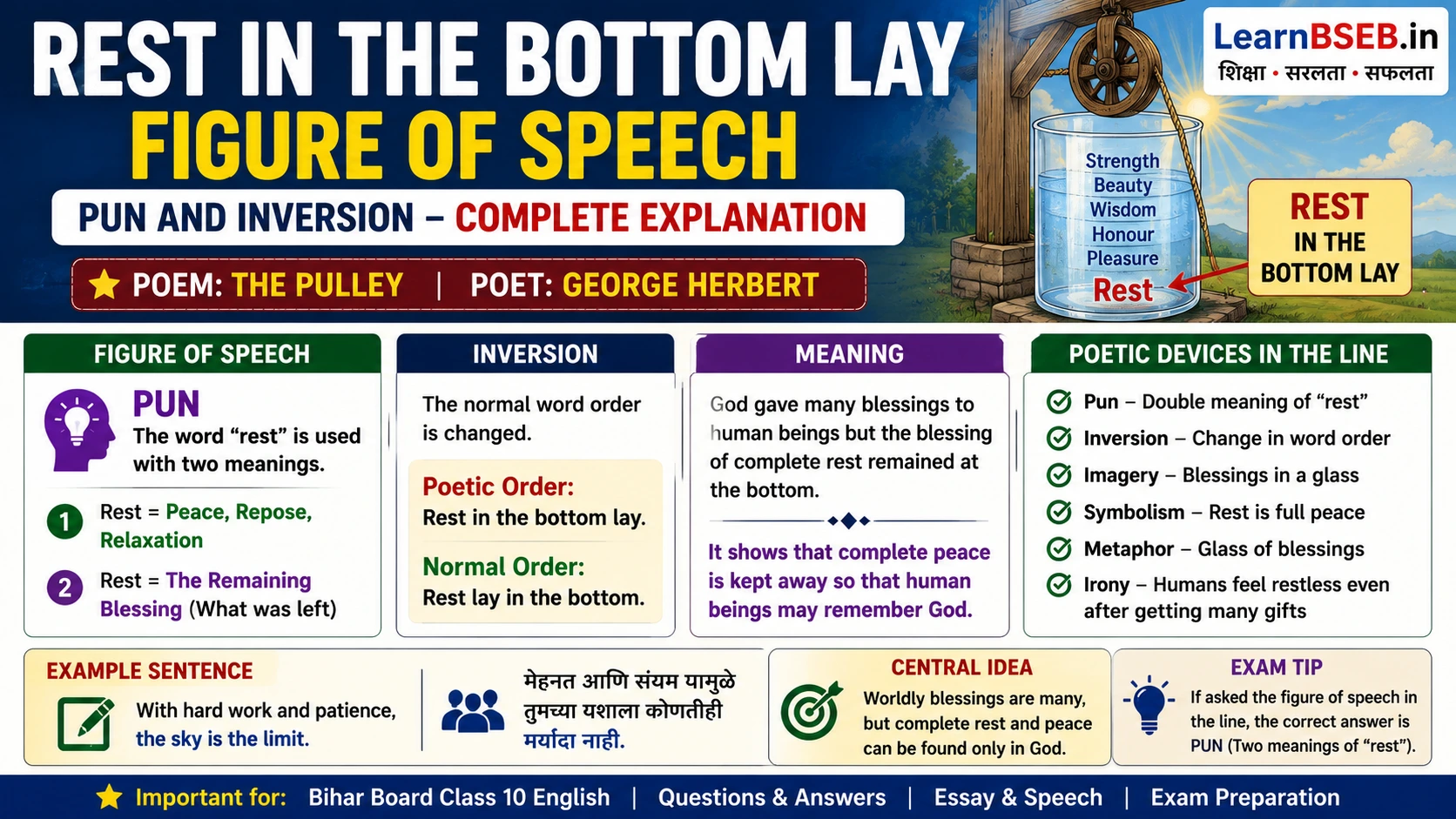
The line “Rest in the bottom lay” is taken from the poem “The Pulley” by George Herbert. The principal figure of speech used in this line is Pun because the word “rest” communicates two related but different meanings at the same time.
In the first sense, “rest” means peace, relaxation or freedom from weariness. In the second sense, it means the remaining part or the blessing that was left after the other blessings had been given to human beings.
Therefore, the correct direct answer is:
“Rest in the bottom lay” is an example of a pun because the word “rest” means both peace or relaxation and the remaining blessing left at the bottom.
The line may also be identified as an example of Inversion because its normal prose order would be:
Rest lay in the bottom.
However, when an examination specifically asks students to explain the figure of speech in this line, Pun is normally the expected answer in the Maharashtra Board Class 10 English exercise. The line appears in Unit 2.4, “The Pulley,” of the Standard 10 Kumarbharati material.
Rest in the Bottom Lay Figure of Speech: Quick Answer
Question | Correct Answer |
Line | Rest in the bottom lay |
Poem | The Pulley |
Poet | George Herbert |
Main figure of speech | Pun |
Pun word | Rest |
First meaning of “rest” | Peace, repose or relaxation |
Second meaning of “rest” | The remainder or what was left |
Additional poetic device | Inversion |
Normal word order | Rest lay at the bottom |
Meaning in context | Rest was the only blessing left in God’s glass |
Main idea | God withheld complete rest so that weariness would draw human beings towards Him |
The original poem describes God giving humanity blessings such as strength, beauty, wisdom, honour and pleasure. When nearly all the blessings had been poured out, “rest” remained at the bottom.
AI Overview-Friendly Answer
The figure of speech in “Rest in the bottom lay” is a pun. The word “rest” has two meanings: it refers to peace or relaxation, and it also refers to the remaining blessing left in God’s glass. The line also contains Inversion because the normal sentence order is “Rest lay in the bottom.”
Exact Exam Answer
Figure of Speech: Pun
It is a Pun because the word “rest” is used with two meanings. It means peace or relaxation, and it also means the remaining blessing left at the bottom of the glass.
One-Sentence Answer
“Rest in the bottom lay” contains a Pun because “rest” means both repose and the remaining part.
Two-Mark Answer
The figure of speech is a pun. The poet uses the word “rest” with two meanings: complete peace or relaxation, and the blessing that remained after the other blessings had been given.
Additional Answer for Inversion
The line also contains Inversion because the words are arranged in an unusual order. The normal prose order is:
Rest lay in the bottom.
Meaning of “Rest in the Bottom Lay”
The line means that when God had distributed almost all His blessings to human beings, the blessing of complete rest was still left at the bottom of the container.
The poet imagines God possessing a glass filled with blessings. He gives humanity many desirable qualities, including strength, beauty, wisdom, honour and pleasure. However, God pauses when He sees that rest remains.
God decides not to give complete rest to human beings. He believes that if people receive every blessing, they may become satisfied with worldly gifts and forget their Creator.
Thus, the line has both a literal function within the poem’s extended image and a deeper spiritual significance.
Simple Meaning
Rest was the only blessing that remained at the bottom.
Student-Friendly Meaning
God gave human beings many qualities, but He did not give them permanent peace and complete satisfaction.
Hindi Explanation
भगवान ने मनुष्य को शक्ति, सुंदरता, बुद्धि, सम्मान और आनंद जैसे अनेक वरदान दिए। अंत में “विश्राम” का वरदान पात्र के नीचे बचा हुआ था। यहां “rest” का अर्थ विश्राम भी है और बचा हुआ भाग भी।
Marathi Explanation
देवाने माणसाला शक्ती, सौंदर्य, बुद्धी, सन्मान आणि आनंद यांसारखे अनेक आशीर्वाद दिले. शेवटी पात्राच्या तळाशी “विश्रांती” उरली होती. येथे “rest” या शब्दाचा अर्थ विश्रांती आणि उरलेला भाग असे दोन्ही होतात.
What Is a Pun?
A Pun is a figure of speech in which a word is used in a way that brings out two meanings, or similar-sounding words are used to create wordplay.
Pun can produce:
- humour;
- irony;
- cleverness;
- ambiguity;
- emphasis;
- a deeper interpretation.
In “Rest in the bottom lay,” the effect is not mainly humorous. The wordplay gives the line philosophical depth.
The Two Meanings of “Rest”
Meaning 1: Peace or Repose
“Rest” means freedom from work, pain, anxiety or weariness.
Example:
The tired student needs some rest.
Here, “rest” means relaxation.
Meaning 2: The Remainder
“Rest” can also mean whatever is left after one part has been used, removed or distributed.
Example:
Some students went home, while the rest stayed in the classroom.
Here, “the rest” means the remaining students.
Both Meanings in the Poem
In the poem:
- Rest is the remaining blessing in the glass.
- Rest is also the blessing of peace and satisfaction.
Because one word carries both meanings simultaneously, the figure of speech is a pun. This is also the explanation provided in Maharashtra Board-oriented solutions for the poem.
Why Is the Line Not Merely a Literal Statement?
At the surface level, the line says that rest was lying at the bottom of a glass of blessings.
However, “rest” is not a physical substance that can literally lie inside a glass. The entire situation is imaginative and symbolic.
The poet turns abstract human qualities into objects that can be collected, poured and distributed. In this imagined scene:
- strength is poured out;
- beauty flows;
- wisdom is given;
- pleasure is distributed;
- rest remains at the bottom.
The image helps the poet explain a spiritual idea through a simple physical action.
Pun and Inversion in the Same Line
A poetic line can contain more than one figure of speech. “Rest in the bottom lay” is a good example.
Pun
The word “rest” has two meanings:
- peace or repose;
- the remaining part.
Inversion
The sentence does not follow normal prose order.
Poetic order:
Rest in the bottom lay.
Normal prose order:
Rest lay in the bottom.
The object or idea receiving emphasis is placed at the beginning. Educational explanations of “The Pulley” also classify the line as an example of inversion in addition to its textbook answer as Pun.
Which Answer Should Students Write?
Type of Question | Best Answer |
“Explain the figure of speech: Rest in the bottom lay” | Pun |
“Why is this line an example of a pun?” | “Rest” has two meanings |
“Find an example of Inversion from the poem” | Rest in the bottom lay |
“Rewrite in normal word order” | Rest lay in the bottom |
“Mention all devices possible in the line” | Pun and Inversion |
Exam Tip: When the question already names “Pun,” explain the two meanings of “rest.” Do not replace the answer with Inversion.
Difference Between Pun and Inversion
Basis | Pun | Inversion |
Meaning | Wordplay involving multiple meanings | Change in the normal order of words |
Focus | Meaning of a word | Sentence structure |
In this line | “Rest” has two meanings | “Rest” is placed before “lay” |
Normal form | Not applicable | Rest lay in the bottom |
Effect | Adds depth and ambiguity | Adds emphasis and poetic rhythm |
Easy Way to Remember
Pun changes or doubles the meaning; Inversion changes the word order.
Context of the Line in “The Pulley”
“The Pulley” presents an imaginary account of the creation of human beings. God has a container filled with blessings and decides to pour them upon humanity.
The blessings include:
- strength;
- beauty;
- wisdom;
- honour;
- pleasure.
When almost everything has been given, God notices that rest is still left. He decides to withhold it because complete rest could make people satisfied only with nature and worldly blessings.
God wants people to remember the source of those blessings. Therefore, human beings possess many gifts but also experience tiredness, dissatisfaction and restlessness. These conditions can eventually turn them towards God.
This is why rest functions as the poem’s metaphorical pulley: its absence creates weariness, and weariness can pull human beings spiritually upward towards their Creator. The poem’s full text presents this movement from blessings to withheld rest and finally to humanity’s return to God.
Why Does God Withhold Rest?
According to the poem’s spiritual argument, God does not withhold rest out of cruelty. He withholds complete satisfaction to prevent humanity from forgetting Him.
If people possessed every possible blessing, they might:
- become completely self-satisfied;
- love the gifts more than the giver;
- remain attached only to the material world;
- forget their spiritual origin;
- feel no need to seek God.
By retaining complete rest, God leaves a sense of incompleteness in human life.
The Deeper Paradox
Human beings are rich in qualities but still weary.
They may possess:
- intelligence but remain anxious;
- wealth but remain dissatisfied;
- beauty but fear its loss;
- honour but desire more recognition;
- pleasure but still feel spiritually empty.
This condition creates the poem’s central paradox: humanity can possess many blessings and yet lack peace.
Significance of the Word “Bottom”
The word “bottom” is important to the poem’s imagery.
At the literal level, it describes the lowest part of God’s imaginary glass of blessings.
At a symbolic level, it suggests:
- the final blessing remaining;
- something precious not yet distributed;
- the hidden foundation of human happiness;
- the one quality that could complete all the others.
Rest lies at the bottom because it is the final and perhaps most important blessing. Without it, the other gifts cannot provide complete satisfaction.
Why Is Rest Called a Precious Gift?
Rest is not simply sleep. In the poem, it represents:
- peace of mind;
- spiritual contentment;
- freedom from dissatisfaction;
- relief from weariness;
- complete inner satisfaction.
A person may be physically inactive but mentally restless. Therefore, the rest discussed in the poem is deeper than ordinary sleep.
It represents a state in which a human being no longer feels incomplete or troubled.
How Does the Pun Support the Poem’s Theme?
The wordplay is central to the poem’s meaning.
When the poet says that “rest” remains, he communicates two ideas at once:
- It is the only item remaining in the glass.
- It is the gift of peace that remains ungiven.
Without the Pun, the line would communicate only one simple idea. Through Pun, the line connects the physical image of a remaining blessing with the spiritual idea of withheld peace.
The figure of speech is therefore not decorative. It carries the poem’s central argument.
Appreciation of the Line
“Rest in the bottom lay” is a short but highly meaningful poetic line. George Herbert uses a pun to give two meanings to the word “rest.” It is both the remaining part of God’s treasure and the gift of peace or relaxation.
The poet also uses Inversion by placing the words in an unusual order. This draws attention immediately to “rest,” which becomes the central idea of the poem.
The line contributes to the poem’s extended metaphor of God pouring blessings from a glass. It marks the turning point at which God pauses and decides whether humanity should receive complete satisfaction.
Thus, the line combines simplicity, wordplay, imagery and spiritual meaning.
About the Poem “The Pulley”
“The Pulley” is a religious and metaphysical poem by George Herbert. It imagines a conversation in which God reflects on the blessings to be given to humanity.
The title refers to a mechanical pulley, which lifts an object by pulling in another direction. In the poem, weariness and restlessness function like a spiritual pulley. They draw human beings back towards God when material goodness alone fails to guide them.
The poem’s text is widely available through the Poetry Foundation, while Maharashtra State educational resources make Balbharati textbooks available digitally.
Central Idea of “The Pulley”
The central idea is that God gives humanity many worldly blessings but withholds complete rest so that people do not forget their Creator.
The poem suggests that goodness may guide a person towards God. However, when goodness fails, exhaustion and dissatisfaction may make the person seek spiritual comfort.
One-Line Central Idea
God withholds complete rest so that human weariness may eventually draw humanity back to Him.
Student-Friendly Central Idea
People may receive intelligence, beauty, honour and pleasure, but they cannot find complete peace only in worldly things.
Important Figures of Speech in “The Pulley”
Metaphor
The “glass of blessings” is a metaphor for the collection of gifts that God gives humanity.
The comparison is indirect. Blessings are imagined as a liquid that can be poured from a glass.
Pun
“Rest” refers both to peace and to the remaining blessing.
Inversion
The normal order of words is changed in “Rest in the bottom lay.”
Paradox
The poem presents human beings as rich in blessings but still weary. These apparently contradictory conditions exist together.
Repetition
Important words and ideas are repeated to emphasise nature, rest and restlessness.
Alliteration
Repeated consonant sounds create a musical effect in phrases involving weariness and restlessness.
Metaphorical Pulley
The mechanical pulley becomes an extended spiritual image. Human weariness pulls a person towards God, just as a pulley lifts an object.
Common Wrong Answers
Wrong Answer 1: Only Inversion
Inversion is present, but the expected textbook answer to the direct figure-of-speech exercise is Pun.
Wrong Answer 2: Metaphor
The broader poem contains metaphor, but the specific wordplay in this line is Pun.
Wrong Answer 3: Euphemism
The line does not use a mild expression to replace something unpleasant. Therefore, Euphemism is not the primary figure of speech.
Wrong Answer 4: Hyperbole
The line does not deliberately exaggerate an idea. Therefore, it is not Hyperbole.
Wrong Answer 5: Rest Means Only Sleep
“Rest” has a broader meaning: peace, repose or relief from weariness. It also means what remains.
Wrong Answer 6: Writing “Rest Means Withholding”
“To withhold” describes God’s action. It is not the second dictionary meaning of “rest.”
The clearer answer is:
Rest means peace, and it also means the remaining part.
Exam-Oriented Questions and Answers
What Is the Figure of Speech in “Rest in the Bottom Lay”?
The figure of speech is a pun because the word “rest” means both peace or relaxation and the remaining blessing.
Explain the Pun in the Line
The poet plays upon the two meanings of “rest.” It means the blessing of peace, and it also refers to what remained in the glass after the other blessings had been distributed.
Identify the Inversion
The poetic order is:
Rest in the bottom lay.
The correct prose order is:
Rest lay in the bottom.
What Was Lying at the Bottom?
The blessing of complete rest was lying at the bottom of God’s glass.
Why Did God Not Give Rest to Humanity?
God feared that human beings would become completely satisfied with worldly gifts and forget their Creator.
What Does Rest Symbolise?
Rest symbolises peace, contentment and freedom from weariness.
How Does Weariness Act Like a Pulley?
Weariness makes human beings seek spiritual peace and therefore draws them towards God.
What Is the Tone of the Line?
The tone is reflective and philosophical because the line introduces God’s decision about the final blessing.
Ready-to-Write Answers
One-Mark Answer
Pun—“rest” means both peace and the remaining blessing.
Two-Mark Answer
The figure of speech is a pun. The word “rest” refers to peace or relaxation and also to what remained at the bottom after the other blessings had been given.
Three-Mark Answer
“Rest in the bottom lay” is an example of Pun because the word “rest” carries two meanings. It means peace or repose, and it also means the remaining part. The line additionally contains Inversion because its normal word order is “Rest lay in the bottom.”
Five-Mark Explanation
The line occurs in George Herbert’s poem “The Pulley.” God has given humanity blessings such as strength, beauty, wisdom, honour and pleasure. Rest remains at the bottom of His glass. The word “rest” creates a Pun because it means both peace and the blessing that remained. The line also uses Inversion, since the normal prose order would be “Rest lay in the bottom.” God eventually withholds this gift so that human weariness may draw people back towards Him.
Original Examples of Pun for Students
Example 1
The bicycle could not stand because it was two-tired.
The expression sounds like “too tired,” while also referring to two tyres.
Example 2
A boiled egg is hard to beat.
“Beat” can mean defeat and also mix an egg by stirring.
Example 3
The fisherman was caught using an illegal net.
“Caught” can refer to physically capturing someone and catching fish.
Example 4
The maths teacher has too many problems.
“Problems” can mean mathematical questions and personal difficulties.
Example 5
The clock was hungry, so it went back four seconds.
“Four seconds” sounds like “for seconds,” producing wordplay.
How These Examples Relate to the Poem
In every example, one word or expression suggests more than one meaning. Similarly, “rest” in the poem means both peace and the remaining part.
How to Identify Pun in an Examination
Use this simple method:
- Read the line twice.
- Identify a word that appears unusual or especially important.
- Check whether it can carry two meanings.
- See whether both meanings fit the context.
- Write both meanings clearly.
- Explain the effect in one sentence.
Formula for Writing the Answer
It is a Pun because the word “” has two meanings: “” and “_____.”
Applied to the line:
It is a Pun because “rest” means peace or relaxation and also the remaining part.
Difference Between Rest, Remainder and Repose
Word | Meaning | Relevance |
Rest | Peace or relaxation | The blessing withheld by God |
The rest | What remains | The remaining blessing |
Remainder | The portion left over | Explains the second meaning |
Repose | A state of peace | Explains the first meaning |
Restlessness | Inability to remain peaceful | Human condition without complete rest |
Weariness | Physical or mental tiredness | The force that may draw humans towards God |
Why Students Search This Exact Line
This line frequently appears in exercises on figures of speech connected with “The Pulley.” Students are commonly asked either to explain why it is a Pun or to identify examples of Inversion from the poem. Maharashtra Board-oriented educational material identifies the poem as Standard 10 Kumarbharati Unit 2.4.
The important point is to recognise that the two answers refer to different features:
- Pun concerns meaning.
- Inversion concerns word order.
Frequently Asked Questions
Is “Rest in the Bottom Lay” a Pun?
Yes. It is a Pun because “rest” refers to peace and also to the remaining blessing.
Is It Also an Example of Inversion?
Yes. The normal prose order is “Rest lay in the bottom.”
What Is the Main Answer in the Textbook Exercise?
Pun is the main expected answer when students are asked to explain the wordplay in the line.
Who Wrote “The Pulley”?
George Herbert wrote the poem “The Pulley.”
What Does “Bottom” Refer To?
It refers to the bottom of God’s imaginary glass or container of blessings.
What Does “Rest” Mean in the First Sense?
It means peace, repose or freedom from weariness.
What Does “Rest” Mean in the Second Sense?
It means the remaining part or what was left.
Why Is It Not Hyperbole?
No extreme exaggeration is used in the line.
Why Is It Not Euphemism?
The poet is not replacing an unpleasant expression with a milder one.
Does the Line Contain a Metaphor?
The broader idea of blessings lying in a glass is metaphorical, but the main word-level device asked in this line is a pun.
What Is the Correct Prose Order?
Rest lay in the bottom.
Why Did the Poet Use Inversion?
It gives emphasis to “rest” and helps maintain the poetic flow.
What Did God Give Humanity Before Rest?
The poem names blessings including strength, beauty, wisdom, honour and pleasure.
Did God Finally Give Complete Rest?
No. In the poem, He deliberately keeps it from humanity.
Why Does God Keep Rest Away?
He wants human beings to remember Him rather than becoming completely satisfied with worldly blessings.
What Is the Moral of “The Pulley”?
Worldly gifts alone cannot provide complete peace. Human restlessness can lead to spiritual awareness.
What Is the Best One-Line Answer?
Pun—“rest” means both peace and the remaining blessing.
Conclusion
The correct answer to “rest in the bottom lay figure of speech” is Pun.
The word “rest” has two meanings:
- peace, repose or relaxation;
- the remaining part or blessing left after the others.
The line also contains Inversion because the normal sentence order is “Rest lay in the bottom.” Pun describes the double meaning, while Inversion describes the unusual word arrangement.
In the context of George Herbert’s “The Pulley,” God gives humanity strength, beauty, wisdom, honour and pleasure but keeps complete rest. This absence of lasting satisfaction makes human beings weary and may eventually draw them towards their Creator.
Therefore, the line is important not only as an examination question but also as the turning point of the poem. Through one carefully chosen word, George Herbert connects the remaining gift in God’s glass with the peace that humanity continually seeks.
Quick Final Revision
Line: Rest in the bottom lay
Main figure of speech: Pun
Reason: “Rest” means peace and the remaining part
Additional device: Inversion
Correct prose order: Rest lay in the bottom
LearnBSEB Internal-Linking Plan
Add these existing LearnBSEB pages naturally within the post: