
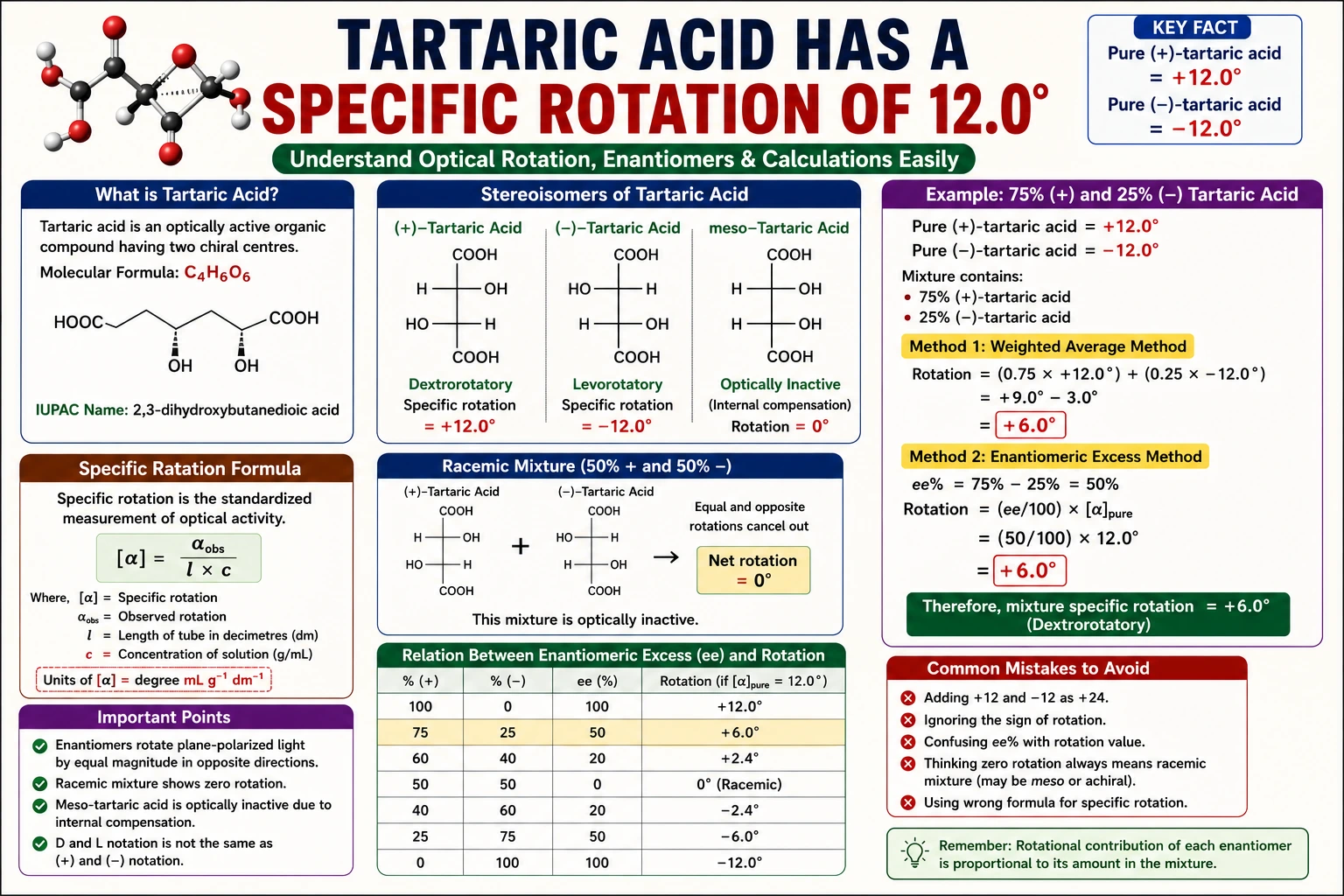
जब किसी प्रश्न में लिखा होता है कि “tartaric acid has a specific rotation of 12.0°”, तो यह सामान्यतः optical activity, enantiomers और enantiomeric mixture की rotation से संबंधित सवाल होता है।
Tartaric acid एक optically active organic compound है, जिसमें दो stereogenic centres होते हैं। इसके optically active enantiomeric forms plane-polarized light को बराबर मात्रा में, लेकिन विपरीत दिशाओं में घुमाते हैं। एक enantiomer का specific rotation positive हो सकता है, जबकि उसके mirror-image enantiomer का specific rotation उतनी ही magnitude के साथ negative होता है। Tartaric acid के stereochemical forms में एक enantiomeric pair और एक achiral meso form शामिल हैं।
उदाहरण के लिए:
- (+)-Tartaric acid का specific rotation = +12.0°
- (−)-Tartaric acid का specific rotation = −12.0°
यदि किसी mixture में दोनों enantiomers बराबर मात्रा में मौजूद हों, तो दोनों की rotations एक-दूसरे को cancel कर देंगी और net rotation zero हो जाएगा। इसे racemic mixture कहा जाता है।
लेकिन यदि एक enantiomer की मात्रा दूसरे से अधिक है, तो mixture optically active रहेगा। इसकी net specific rotation excess enantiomer की direction में होगी।
इस article में हम specific rotation का अर्थ, formula, tartaric acid के stereoisomers, racemic mixture, enantiomeric excess और numerical calculations को step-by-step समझेंगे।
Quick Answer
यदि pure (+)-tartaric acid का specific rotation +12.0° है, तो pure (−)-tartaric acid का specific rotation:
−12.0°
होगा।
यदि mixture में:
- 75% (+)-tartaric acid
- 25% (−)-tartaric acid
है, तो net specific rotation:
(0.75 × 12.0°) + (0.25 × −12.0°)
= 9.0° − 3.0°
= +6.0°
अतः mixture का specific rotation:
+6.0°
होगा।
यह result positive है, इसलिए mixture dextrorotatory है और उसमें (+)-enantiomer excess में मौजूद है। इसी प्रकार के standard question का उत्तर weighted contribution से +6.0° निकलता है।
Tartaric Acid क्या है?
Tartaric acid एक naturally occurring crystalline organic acid है। इसका molecular formula:
C₄H₆O₆
है।
यह विशेष रूप से grapes और wine-related products में पाया जाता है। L-(+)-tartaric acid प्राकृतिक रूप से grapes और wine में मिलने वाला प्रमुख tartaric acid form है।
इसका systematic name:
2,3-dihydroxybutanedioic acid
है।
इसकी simplified structural formula:
HOOC–CHOH–CHOH–COOH
है।
Molecule में दो carbon atoms ऐसे होते हैं जिनसे चार अलग-अलग groups जुड़े हो सकते हैं। इन्हें stereogenic या chiral centres कहा जाता है।
Tartaric Acid Optical Isomerism क्यों दिखाता है?
Optical isomerism तब उत्पन्न होता है जब किसी molecule और उसके mirror image को एक-दूसरे पर पूरी तरह superimpose नहीं किया जा सकता।
ऐसे mirror-image molecules को enantiomers कहा जाता है।
Tartaric acid में दो stereogenic centres होते हैं। इसलिए इसकी stereochemistry साधारण one-chiral-centre molecules से थोड़ी अधिक interesting होती है।
इसके प्रमुख stereochemical forms हैं:
- (+)-Tartaric acid
- (−)-Tartaric acid
- meso-Tartaric acid
इसके अतिरिक्त (+) और (−) forms के equimolar mixture को racemic tartaric acid कहा जा सकता है।
(+)-Tartaric Acid
यह plane-polarized light को clockwise या right direction में rotate करता है।
इसे dextrorotatory form कहा जाता है।
इसे सामान्यतः:
(+)-tartaric acid
से दर्शाया जाता है।
(−)-Tartaric Acid
यह plane-polarized light को anticlockwise या left direction में rotate करता है।
इसे levorotatory form कहा जाता है।
इसे:
(−)-tartaric acid
से दर्शाया जाता है।
meso-Tartaric Acid
Meso-tartaric acid में stereogenic centres तो होते हैं, लेकिन molecule में internal symmetry होने के कारण इसकी net optical rotation zero होती है।
यह optically inactive होता है क्योंकि molecule के भीतर optical effects internally cancel हो जाते हैं।
Racemic Tartaric Acid
Racemic mixture में (+) और (−) enantiomers समान मात्रा में होते हैं।
एक enantiomer जितना light को right rotate करता है, दूसरा उतना ही left rotate करता है।
इसलिए:
Net rotation = 0°
होती है।
Optical Rotation क्या है?
जब plane-polarized light किसी optically active compound के solution से गुजरती है, तो light का plane rotate हो सकता है।
यदि rotation clockwise direction में हो, तो इसे positive या dextrorotatory rotation कहा जाता है।
यदि rotation anticlockwise हो, तो इसे negative या levorotatory rotation कहा जाता है।
Rotation को polarimeter नामक instrument से measure किया जाता है।
Observed Rotation क्या है?
Experiment में polarimeter द्वारा directly measured angle को observed rotation कहते हैं।
इसे सामान्यतः:
αobs
या केवल:
α
से दर्शाया जाता है।
Observed rotation निम्न factors पर निर्भर करती है:
- Sample concentration
- Tube length
- Temperature
- Light wavelength
- Solvent
- Compound की identity
- Enantiomeric composition
इसलिए केवल observed rotation किसी compound की universal property नहीं है।
Specific Rotation क्या है?
Specific rotation optical activity का standardized measurement है।
यह observed rotation को concentration और path length के अनुसार normalize करता है।
Liquid solution के लिए commonly used formula है:
[α] = αobs / (l × c)
जहां:
- [α] = Specific rotation
- αobs = Observed rotation
- l = Polarimeter tube की length in decimetres
- c = Solution concentration
Temperature और wavelength को अक्सर notation में लिखा जाता है:
[α]ᴰ²⁰
यह बताता है कि measurement 20°C पर sodium D-line के साथ की गई है।
Specific Rotation और Observed Rotation में अंतर
Specific Rotation | Observed Rotation |
Compound की standardized optical property | Experiment में measured angle |
Concentration और path length के लिए corrected | Concentration पर depend करता है |
निश्चित conditions के साथ लिखा जाता है | Instrument से directly मिलता है |
[α] से represent होता है | αobs से represent होता है |
Enantiomer पहचानने में उपयोगी | Specific rotation calculate करने में उपयोगी |
Enantiomers की Specific Rotation
Enantiomers के physical properties सामान्य achiral environment में लगभग समान होते हैं, लेकिन उनका optical rotation opposite direction में होता है।
यदि एक pure enantiomer की specific rotation:
+12.0°
है, तो उसके pure mirror-image enantiomer की specific rotation:
−12.0°
होगी।
Magnitude समान रहती है:
|+12.0°| = |−12.0°|
लेकिन direction opposite होती है।
Tartaric acid के enantiomeric forms के लिए commonly reported values में लगभग +12° और −12° जैसे opposite rotations मिलते हैं, जबकि meso और racemic forms का net rotation zero होता है।
Main Numerical: 75% (+) और 25% (−) Tartaric Acid
मान लीजिए:
- Pure (+)-tartaric acid का specific rotation = +12.0°
- Pure (−)-tartaric acid का specific rotation = −12.0°
- Mixture में (+)-form = 75%
- Mixture में (−)-form = 25%
Method 1: Weighted Average Method
Mixture की net specific rotation दोनों forms के weighted contributions से मिलेगी।
(+)-Enantiomer Contribution
0.75 × (+12.0°) = +9.0°
(−)-Enantiomer Contribution
0.25 × (−12.0°) = −3.0°
Net Rotation
+9.0° − 3.0° = +6.0°
अतः:
Mixture specific rotation = +6.0°
Method 2: Enantiomeric Excess Method
Enantiomeric excess:
ee = Percentage of major enantiomer − Percentage of minor enantiomer
इस question में:
ee = 75% − 25%
ee = 50%
अब:
Observed specific rotation of mixture = ee fraction × pure enantiomer rotation
= 0.50 × 12.0°
= +6.0°
दोनों methods से समान उत्तर मिलता है।
Enantiomeric Excess क्या है?
Enantiomeric excess बताता है कि mixture में एक enantiomer दूसरे की तुलना में कितने प्रतिशत अधिक है।
Formula:
ee% = |% major enantiomer − % minor enantiomer|
यदि mixture में:
- 75% (+)
- 25% (−)
है, तो:
ee = 75 − 25 = 50%
इसका अर्थ यह नहीं कि केवल 50% sample optically active molecules से बना है। इसका अर्थ यह है कि 50 percentage points का net excess (+)-enantiomer का है।
Mixture को conceptually इस प्रकार समझा जा सकता है:
- 25% (+) और 25% (−) मिलकर 50% racemic portion बनाते हैं।
- बचा हुआ 50% pure excess (+)-enantiomer है।
यही 50% excess net optical rotation उत्पन्न करता है।
Enantiomeric Excess और Specific Rotation का Relation
जब pure enantiomer का specific rotation ज्ञात हो:
ee% = (Observed specific rotation / Pure specific rotation) × 100
या:
[α]mixture = (ee/100) × [α]pure
Sign major enantiomer की direction बताता है।
Example
Pure tartaric acid rotation:
+12.0°
Mixture rotation:
+9.0°
तो:
ee = (9/12) × 100
ee = 75%
Mixture में (+)-enantiomer excess 75% है।
Enantiomer Percentage कैसे निकालें?
यदि enantiomeric excess ज्ञात हो, तो major और minor enantiomer percentages निकाल सकते हैं।
Formula:
Major enantiomer % = (100 + ee)/2
Minor enantiomer % = (100 − ee)/2
Example
यदि ee = 50%:
Major = (100 + 50)/2 = 75%
Minor = (100 − 50)/2 = 25%
अतः mixture:
- 75% major enantiomer
- 25% minor enantiomer
होगा।
अलग-अलग Mixtures के Examples
Example 1: 50% (+) और 50% (−)
Pure rotation = ±12.0°
Net rotation:
(0.50 × 12) + (0.50 × −12)
= 6 − 6
= 0°
यह racemic mixture है।
Example 2: 100% (+)
Net rotation:
1.00 × +12.0° = +12.0°
यह enantiomerically pure (+)-tartaric acid है।
Example 3: 100% (−)
Net rotation:
1.00 × −12.0° = −12.0°
यह pure (−)-tartaric acid है।
Example 4: 60% (+) और 40% (−)
Weighted rotation:
0.60 × 12 + 0.40 × −12
= 7.2 − 4.8
= +2.4°
या:
ee = 60 − 40 = 20%
Rotation = 0.20 × 12 = +2.4°
Example 5: 30% (+) और 70% (−)
ee = 70 − 30 = 40%
Major enantiomer negative है।
Rotation = 0.40 × −12
= −4.8°
Example 6: Mixture Rotation +3.0°
Pure rotation = +12.0°
ee = (3/12) × 100
ee = 25%
Major (+)-enantiomer:
(100 + 25)/2 = 62.5%
Minor (−)-enantiomer:
(100 − 25)/2 = 37.5%
Rotation का Positive और Negative Sign
Rotation की magnitude और sign दोनों महत्वपूर्ण हैं।
Positive Sign
+6.0°
बताता है कि mixture plane-polarized light को right direction में rotate करता है और (+)-enantiomer excess में है।
Negative Sign
−6.0°
बताता है कि mixture left direction में rotate करता है और (−)-enantiomer excess में है।
Zero Rotation
0°
कई संभावनाओं को दर्शा सकता है:
- Racemic mixture
- Achiral compound
- Meso compound
- बहुत dilute sample
- Experimental error
- Opposite rotations का cancellation
इसलिए zero rotation देखकर सीधे racemic mixture कहना हमेशा पर्याप्त नहीं है। Molecular structure और experimental conditions भी समझनी चाहिए।
Racemic Mixture और meso Compound में अंतर
दोनों optically inactive हो सकते हैं, लेकिन कारण अलग हैं।
Racemic Mixture | meso Compound |
दो enantiomers का 1:1 mixture | एक single achiral molecule |
External compensation | Internal compensation |
(+) और (−) molecules अलग मौजूद | Molecule में symmetry होती है |
Resolution संभव हो सकती है | Enantiomer pair नहीं होता |
Net rotation zero | Net rotation zero |
External Compensation
Racemic mixture में अलग-अलग (+) और (−) molecules की rotations बाहर से एक-दूसरे को cancel करती हैं।
Internal Compensation
Meso compound में molecule के भीतर symmetry के कारण optical effects internally cancel हो जाते हैं।
D/L और (+)/(−) एक ही चीज नहीं हैं
Students अक्सर D, L, positive और negative notation को एक ही समझ लेते हैं।
यह गलत है।
(+) और (−)
ये experimentally measured optical rotation direction बताते हैं।
- (+) = Dextrorotatory
- (−) = Levorotatory
D और L
ये relative configuration notation हैं, जो glyceraldehyde reference system से जुड़ी होती हैं।
किसी compound का D होना यह guarantee नहीं करता कि वह positive rotation करेगा।
इसी प्रकार L होने का अर्थ automatically negative rotation नहीं है।
Tartaric acid के naming conventions historical reasons से confusing हो सकते हैं। इसलिए numerical question में दिए गए (+) और (−) signs को ही follow करें।
R/S और Optical Rotation
R और S absolute configuration बताते हैं।
लेकिन:
- R का अर्थ हमेशा (+) नहीं होता।
- S का अर्थ हमेशा (−) नहीं होता।
Optical rotation experimentally determine की जाती है।
Structure देखकर केवल R/S assignment से rotation direction हमेशा predict नहीं की जा सकती।
Specific Rotation किन Conditions पर निर्भर कर सकती है?
Specific rotation को characteristic property माना जाता है, लेकिन reported value measurement conditions के साथ दी जाती है।
महत्वपूर्ण conditions:
- Temperature
- Wavelength
- Solvent
- Concentration
- Sample purity
- Chemical form
- pH
- Association या dissociation
इसीलिए scientific notation में solvent और concentration भी लिखे जा सकते हैं।
उदाहरण:
[α]ᴰ²⁰ = +12.0° (c = 20, H₂O)
इसका अर्थ है कि measurement specified temperature, wavelength, concentration और solvent conditions के साथ किया गया है।
Polarimeter कैसे काम करता है?
Polarimeter optical rotation measure करने वाला instrument है।
इसके मुख्य parts:
- Light source
- Polarizer
- Sample tube
- Analyzer
- Detector या viewing system
Working Process
- Ordinary light polarizer से गुजरती है।
- Plane-polarized light बनती है।
- Light optically active sample से गुजरती है।
- Sample light plane rotate करता है।
- Analyzer rotation angle measure करता है।
Observed Rotation Numerical
मान लीजिए:
- Specific rotation = +12.0°
- Concentration = 0.20 g/mL
- Tube length = 2 dm
Formula:
αobs = [α] × l × c
= 12.0 × 2 × 0.20
= +4.8°
अतः observed rotation:
+4.8°
होगी।
Reverse Calculation
यदि:
- Observed rotation = +3.6°
- Tube length = 1.5 dm
- Concentration = 0.20 g/mL
तो:
[α] = αobs / l × c
सही grouping के साथ:
[α] = αobs / (l × c)
= 3.6 / (1.5 × 0.20)
= 3.6 / 0.30
= +12.0°
Common Mistakes Students Make
Mistake 1: दोनों Rotations को Add करना
गलत:
12 + 12 = 24°
Enantiomers opposite directions में rotate करते हैं। Signs का उपयोग करना जरूरी है।
सही:
(+12) और (−12)
Mistake 2: Percentages का उपयोग न करना
75% को calculation में:
75
नहीं, बल्कि:
0.75
के रूप में use करें।
Mistake 3: 75 − 25 = 50 को Final Rotation समझना
50 enantiomeric excess percentage है, rotation नहीं।
Rotation:
0.50 × 12 = 6°
होगी।
Mistake 4: Racemic Mixture को meso Compound समझना
दोनों optically inactive हैं, लेकिन structural reason अलग है।
Mistake 5: D का अर्थ Positive मानना
D/L और (+)/(−) अलग notation systems हैं।
Mistake 6: Sign भूल जाना
Answer केवल 6.0° लिखना अधूरा हो सकता है।
सही answer:
+6.0°
Mistake 7: Observed और Specific Rotation को Same मानना
Observed rotation concentration और path length पर depend करती है।
Specific rotation standardized value है।
Mistake 8: Formula में Brackets भूलना
सही formula:
[α] = αobs / (l × c)
न कि:
[α] = (αobs/l) × c
Exam में Answer कैसे लिखें?
One-Mark Answer
If (+)-tartaric acid has a specific rotation of +12.0°, its enantiomer has a specific rotation of −12.0°.
Two-Mark Answer
For a mixture containing 75% (+)-tartaric acid and 25% (−)-tartaric acid:
[α]mixture = (0.75 × 12.0) + (0.25 × −12.0)
= +6.0°
Therefore, the mixture is dextrorotatory.
Three-Mark Answer
The two enantiomers of tartaric acid rotate plane-polarized light by equal amounts in opposite directions. If the mixture contains 75% (+)-form and 25% (−)-form:
Net rotation = 9.0° − 3.0° = +6.0°
Alternatively, the enantiomeric excess is:
75% − 25% = 50%
Therefore:
[α]mixture = 0.50 × 12.0° = +6.0°
Practice Questions
Question 1
Pure (+)-tartaric acid has a specific rotation of +12.0°. What is the rotation of pure (−)-tartaric acid?
Answer: −12.0°
Question 2
A mixture contains 50% (+) and 50% (−)-tartaric acid. Calculate its rotation.
Answer: 0°
Question 3
A mixture contains 80% (+) and 20% (−)-tartaric acid. Calculate its specific rotation.
Solution:
ee = 80 − 20 = 60%
Rotation = 0.60 × 12 = +7.2°
Question 4
A mixture has a specific rotation of −3.0°. Pure enantiomer rotation is 12.0°. Find ee.
Solution:
ee = (3/12) × 100 = 25%
Negative enantiomer excess = 25%.
Question 5
A tartaric acid sample has 40% ee in favour of (+)-form. Find enantiomer percentages.
Answer:
Major:
(100 + 40)/2 = 70%
Minor:
(100 − 40)/2 = 30%
Multiple-Choice Questions
1. Pure (+)-tartaric acid has rotation +12°. Its enantiomer has:
- +24°
B. −12°
C. 0°
D. −24°
Answer: B. −12°
2. A 1:1 mixture of two enantiomers is called:
- Meso compound
B. Diastereomer
C. Racemic mixture
D. Achiral reagent
Answer: C. Racemic mixture
3. A mixture contains 75% (+) and 25% (−) tartaric acid. Its ee is:
- 25%
B. 50%
C. 75%
D. 100%
Answer: B. 50%
4. The specific rotation of the above mixture is:
- +3°
B. −6°
C. +6°
D. 0°
Answer: C. +6°
5. Which instrument measures optical rotation?
- Calorimeter
B. Polarimeter
C. Spectrometer only
D. Barometer
Answer: B. Polarimeter
Frequently Asked Questions
What does “tartaric acid has a specific rotation of 12.0” mean?
It means a pure optically active form of tartaric acid rotates plane-polarized light by a standardized value of 12.0° under specified measurement conditions.
If (+)-tartaric acid is +12°, what is (−)-tartaric acid?
Its specific rotation is −12° under the same conditions.
What is the rotation of a 75:25 mixture?
For 75% (+) and 25% (−), the rotation is +6.0°.
Why is the answer not +9°?
The 75% positive enantiomer contributes +9°, but the 25% negative enantiomer contributes −3°. Net rotation is +6°.
What is enantiomeric excess in this mixture?
50%.
What happens in a racemic mixture?
Equal amounts of enantiomers rotate light equally in opposite directions, producing zero net rotation.
Is meso-tartaric acid racemic?
No. Meso-tartaric acid is a single achiral compound, जबकि racemic mixture दो enantiomers का equal mixture होता है।
Does zero rotation always mean racemic mixture?
No. The sample may be racemic, meso, achiral, very dilute or measured incorrectly.
Is specific rotation always exactly 12°?
Reported value depends on the chemical form and stated temperature, wavelength, solvent and concentration conditions. Use the value given in the question.
Can R/S notation predict positive or negative rotation?
Not reliably. Optical direction must be measured experimentally.
What is the formula for enantiomeric excess?
ee% = |major enantiomer % − minor enantiomer %|
How do we find ee from rotation?
ee% = (observed specific rotation / pure specific rotation) × 100
Use magnitude first and then determine the major enantiomer from the sign.
Conclusion
The keyword “tartaric acid has a specific rotation of 12.0” usually refers to an optical-rotation numerical involving tartaric acid enantiomers.
The central concept is that enantiomers rotate plane-polarized light by equal magnitudes in opposite directions.
Therefore:
- (+)-Tartaric acid = +12.0°
- (−)-Tartaric acid = −12.0°
- 50:50 mixture = 0°
- 75:25 mixture = +6.0°, if the positive form is 75%
For a 75% (+) and 25% (−) mixture:
[α]mixture = (0.75 × +12.0°) + (0.25 × −12.0°)
= +9.0° − 3.0°
= +6.0°
The same result can be obtained using enantiomeric excess:
ee = 75% − 25% = 50%
[α]mixture = 0.50 × 12.0° = +6.0°
Students should remember that racemic mixtures and meso compounds may both have zero net rotation, but their reasons are different. Racemic mixtures show external compensation, while meso compounds show internal compensation.
The most important formulas are:
[α] = αobs / (l × c)
ee% = |% major − % minor|
[α]mixture = (ee/100) × [α]pure
इन concepts को समझ लेने के बाद tartaric acid, enantiomeric excess और specific rotation से जुड़े अधिकांश examination numericals आसानी से solve किए जा सकते हैं।