
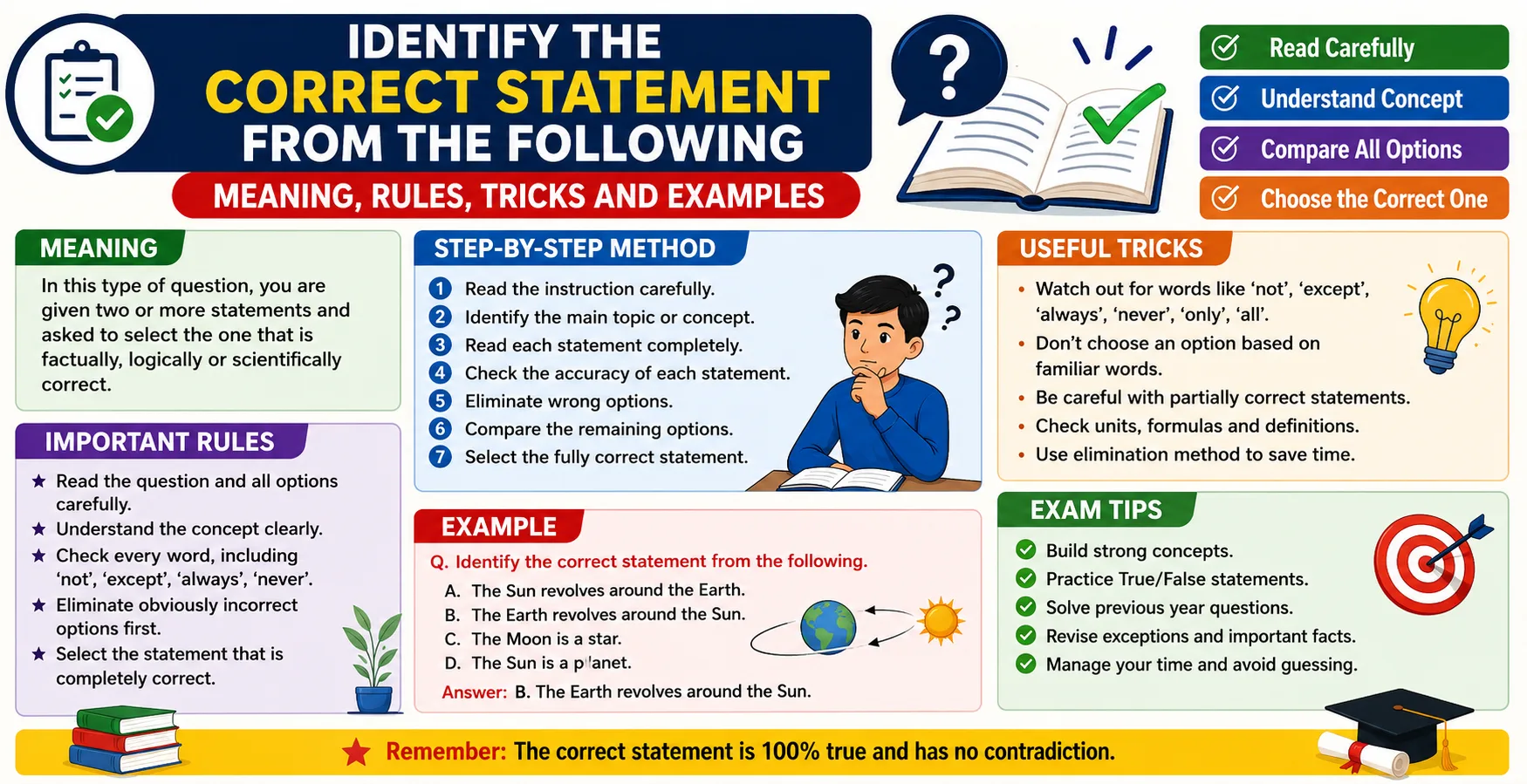
The instruction “identify the correct statement from the following” is commonly used in school examinations, competitive exams, entrance tests and online quizzes. In this type of question, students are given two or more statements and asked to select the statement that is factually, logically or scientifically correct.
Although these questions may look simple, they can be confusing because all the options are often written in a similar style. Sometimes one option is completely correct, while another option contains only one incorrect word. In other cases, two statements may appear correct, but only one of them fully answers the question.
To solve these questions accurately, students must understand the concept, read every word carefully and compare all the available options. Guessing only from familiar words may lead to the wrong answer.
This detailed guide explains the meaning of identify the correct statement from the following, the best method to solve such questions, important rules, common mistakes and subject-wise examples.
What Does “Identify the Correct Statement from the Following” Mean?
The phrase “identify the correct statement from the following” means that you must examine all the given statements and select the one that contains accurate information.
For example:
Question: Identify the correct statement from the following.
- The Sun revolves around the Earth.
B. The Earth revolves around the Sun.
C. The Moon is a star.
D. The Sun is a planet.
Correct answer: B. The Earth revolves around the Sun.
The correct option is selected because the Earth moves around the Sun. The other statements are scientifically incorrect.
In simple words, the question asks:
- Which statement is true?
- Which option contains the correct fact?
- Which sentence follows the accepted rule or concept?
- Which statement is not misleading or incomplete?
Students should understand that the correct statement must be accurate as a whole. Even if most parts of a sentence are correct, one wrong word can make the entire statement incorrect.
Why Are Correct Statement Questions Asked in Examinations?
Correct statement questions are used to test more than memorisation. They check whether a student can understand, compare and apply concepts.
These questions help examiners evaluate:
- Conceptual understanding
- Reading accuracy
- Logical reasoning
- Ability to distinguish between similar facts
- Knowledge of definitions and rules
- Attention to small details
- Decision-making skills
For example, a student may know that plants prepare food through photosynthesis. However, the examiner may present the following options:
- Photosynthesis occurs only during the night.
B. Photosynthesis takes place mainly in green leaves.
C. Photosynthesis does not require sunlight.
D. Photosynthesis releases carbon dioxide as its main product.
A student who has understood the concept will select option B. A student who has only memorised a few words may become confused by the use of terms such as sunlight, carbon dioxide and green leaves.
Types of “Identify the Correct Statement” Questions
Different examinations use different forms of statement-based questions. Understanding the question format is the first step towards solving it correctly.
Single Correct Statement
In this type, only one option is correct.
Example:
Identify the correct statement from the following.
- Water freezes at 100°C.
B. Water boils at 0°C.
C. Water freezes at 0°C under normal conditions.
D. Water is always found only in liquid form.
Answer: C
Only one statement gives the correct scientific fact.
Multiple Correct Statements
In some questions, more than one statement may be correct. The instruction may say:
- Select all the correct statements.
- Identify the correct statements.
- Choose the correct combination.
- More than one option may be correct.
Students must read the instruction carefully because selecting only one option may result in an incomplete answer.
Example:
Which of the following statements are correct?
- Plants require sunlight for photosynthesis.
- Chlorophyll helps absorb light energy.
- Oxygen is consumed as the main raw material in photosynthesis.
- Carbon dioxide is used during photosynthesis.
Correct statements: 1, 2 and 4.
Statement I and Statement II
In this question pattern, two statements are given, followed by combination-based options.
Example:
Statement I: Metals are generally good conductors of electricity.
Statement II: Copper is used in electrical wiring.
- Both Statement I and Statement II are correct.
B. Statement I is correct, but Statement II is incorrect.
C. Statement I is incorrect, but Statement II is correct.
D. Both statements are incorrect.
Answer: A
Both statements are correct.
Assertion and Reason Questions
Assertion-reason questions are an advanced form of statement-based MCQs.
Assertion: Green plants prepare their own food.
Reason: Green plants contain chlorophyll that captures sunlight.
Possible options may include:
- Both assertion and reason are true, and the reason correctly explains the assertion.
B. Both assertion and reason are true, but the reason does not explain the assertion.
C. Assertion is true, but reason is false.
D. Assertion is false, but reason is true.
Correct answer: A
Both statements are true, and chlorophyll’s role explains why green plants can prepare food.
Identify the Incorrect Statement
This format is the opposite of identify the correct statement from the following.
The question may say:
- Identify the incorrect statement.
- Which of the following is not correct?
- Select the false statement.
- Choose the option that does not apply.
Students often make mistakes because they automatically search for the correct option without noticing the word “incorrect” or “not.”
Correctly Matched Statement
In this type, students must identify the correctly matched pair.
Example:
- Heart — Digestion
B. Kidney — Excretion
C. Lungs — Blood formation
D. Stomach — Respiration
Answer: B. Kidney — Excretion
The kidney is correctly matched with its primary function of removing waste from the blood.
How to Identify the Correct Statement from the Following
A systematic approach can improve both speed and accuracy.
Read the Question Instruction Carefully
Before reading the options, identify what the question is asking.
Look for words such as:
- Correct
- Incorrect
- True
- False
- Except
- Not correct
- Most appropriate
- Best statement
- Correctly matched
The words not, incorrect and except can completely change the meaning of the question.
For example:
“Identify the correct statement” asks for the true option.
“Identify the statement that is not correct” asks for the false option.
Ignoring one small word may cause a correct concept to produce a wrong answer.
Understand the Main Topic
Find out which concept is being tested. The question may relate to science, mathematics, English grammar, social science, computers or general knowledge.
Ask yourself:
- What chapter does this question belong to?
- Which rule or definition is relevant?
- What fact do I already know about this topic?
Once the central concept becomes clear, incorrect options are easier to eliminate.
Examine Every Word of Each Statement
Do not select an option only because it looks familiar. Read the complete sentence.
Pay special attention to words such as:
- Always
- Never
- Only
- All
- None
- Sometimes
- Usually
- Mainly
- Can
- Cannot
- Must
Absolute words like “always” and “never” often make a statement incorrect unless the rule has no exception.
Consider these two statements:
- Metals are always hard.
- Most metals are hard, but some metals such as sodium are soft.
The second statement is correct because it acknowledges exceptions.
Divide Long Statements into Smaller Parts
A long option may contain two or three claims. Each claim must be checked separately.
Example:
“Photosynthesis occurs in chloroplasts, uses carbon dioxide and releases nitrogen.”
This statement contains three parts:
- Photosynthesis occurs in chloroplasts — correct.
- It uses carbon dioxide — correct.
- It releases nitrogen — incorrect.
Therefore, the whole statement is incorrect.
Apply the Elimination Method
When you are unsure of the correct answer, remove the clearly incorrect options first.
Suppose four options are given:
- One contradicts a basic definition.
- One contains an incorrect unit.
- One uses an extreme word without justification.
- One matches the textbook concept.
By eliminating the first three, the correct answer becomes easier to identify.
The elimination method is particularly useful in competitive examinations where negative marking is applied.
Compare Similar Options
Examiners often provide two options that differ by only one word.
Example:
- The resistance of a conductor increases with an increase in length.
B. The resistance of a conductor decreases with an increase in length.
The words “increases” and “decreases” determine the answer. According to the relation:
R ∝ L
Resistance increases with the length of the conductor. Therefore, option A is correct.
Check Units, Signs and Formulae
In mathematics and science, a statement may appear correct but contain the wrong formula, unit or sign.
For example:
- The SI unit of electric current is volt.
B. The SI unit of electric current is ampere.
The correct statement is B.
Similarly:
- Speed = Distance × Time
B. Speed = Distance ÷ Time
The correct formula is option B.
Select the Most Complete Statement
Sometimes two statements contain correct information, but one is more complete and accurate.
Example:
- Respiration releases energy.
B. Cellular respiration breaks down food to release usable energy in living cells.
Both statements appear correct, but option B is more complete if the question asks for the best definition of cellular respiration.
Important Tricks for Correct Statement Questions
Students can apply the following practical tricks during examinations.
Watch for Absolute Words
Statements containing words like “all,” “only,” “never” and “always” should be checked carefully.
Example:
“All metals are solid at room temperature.”
This is incorrect because mercury is liquid at room temperature.
A more accurate statement would be:
“Most metals are solid at room temperature, but mercury is liquid.”
Look for Exceptions
Many scientific and grammatical rules have exceptions. An option that ignores a well-known exception may be incorrect.
For example:
“Every non-metal is a poor conductor of electricity.”
This is incorrect because graphite, a form of carbon, conducts electricity.
Verify Cause-and-Effect Relationships
A statement may contain two correct facts but connect them incorrectly.
Example:
“Plants appear green because chlorophyll absorbs green light most strongly.”
Plants appear green, and chlorophyll absorbs light, but the explanation is incorrect. Chlorophyll reflects more green light, which is why leaves appear green.
Be Careful with Reversed Facts
Some options deliberately reverse the relationship between two concepts.
Example:
- Arteries carry blood away from the heart.
B. Arteries carry blood towards the heart.
The correct statement is A.
Veins generally carry blood towards the heart, while arteries carry blood away from it.
Use Textbook Language
In school examinations, the statement closest to the prescribed textbook definition is generally preferred.
Students should learn:
- Standard definitions
- Scientific terminology
- Formulae
- Important exceptions
- Diagrams and labels
- Cause-and-effect relationships
Avoid selecting an option merely because it sounds practical if it differs from the accepted textbook concept.
Subject-Wise Solved Examples
Science Examples
Biology Example
Identify the correct statement from the following.
- The heart is an organ of the digestive system.
B. The lungs pump blood throughout the body.
C. The kidneys help remove waste materials from the blood.
D. The stomach is the main organ of respiration.
Correct answer: C
The kidneys filter blood and help remove nitrogenous waste by forming urine.
Chemistry Example
Identify the correct statement from the following.
- Acids turn blue litmus red.
B. Bases turn blue litmus red.
C. Acids release hydroxide ions in water.
D. Sodium chloride is a strong acid.
Correct answer: A
Acids turn blue litmus paper red. Bases generally turn red litmus paper blue.
Physics Example
Identify the correct statement from the following.
- Electric current is measured in ampere.
B. Resistance is measured in watt.
C. Power is measured in volt.
D. Potential difference is measured in ohm.
Correct answer: A
The SI unit of electric current is ampere.
Environmental Science Example
Identify the correct statement from the following.
- Plastic is easily biodegradable.
B. Decomposers help recycle nutrients in an ecosystem.
C. Energy increases at every trophic level.
D. Ozone is responsible for all water pollution.
Correct answer: B
Decomposers break down dead organic matter and return nutrients to the environment.
Mathematics Examples
Basic Mathematics
Identify the correct statement from the following.
- The sum of angles of a triangle is 180°.
B. The sum of angles of a triangle is 360°.
C. Every triangle has four sides.
D. A right angle measures 45°.
Correct answer: A
The sum of the three interior angles of a triangle is 180 degrees.
Algebra Example
Identify the correct statement.
- (a^m \times a^n = a^{m+n})
B. (a^m \times a^n = a^{mn})
C. (a^m + a^n = a^{m+n}) in every case
D. (a^0 = 0)
Correct answer: A
When powers with the same base are multiplied, their exponents are added.
Probability Example
Identify the correct statement from the following.
- Probability can be greater than 1.
B. Probability always lies between 0 and 1.
C. Probability is always negative.
D. The probability of a certain event is 0.
Correct answer: B
The probability of an event lies between 0 and 1, including both limits.
English Grammar Examples
Parts of Speech
Identify the correct statement.
- A noun names a person, place, thing or idea.
B. A verb always names a place.
C. An adjective replaces a noun.
D. A pronoun describes an action.
Correct answer: A
A noun is the name of a person, place, thing or idea.
Tense Example
Identify the correct sentence.
- She go to school every day.
B. She goes to school every day.
C. She going to school every day.
D. She gone to school every day.
Correct answer: B
With the third-person singular subject “she” in the simple present tense, the verb takes “s” or “es.”
Article Example
Identify the correct statement.
- “An” is generally used before a vowel sound.
B. “A” is always used before every vowel letter.
C. “The” can never be used before a unique object.
D. Articles are used only with verbs.
Correct answer: A
The use of “a” or “an” depends on sound, not merely on the first letter.
For example:
- An hour
- A university
“Hour” begins with a consonant letter but has a vowel sound. “University” begins with a vowel letter but has a consonant sound.
Social Science Examples
History Example
Identify the correct statement from the following.
- The French Revolution began in 1789.
B. The French Revolution began in 1947.
C. The Industrial Revolution began first in India.
D. Democracy means rule by a hereditary king.
Correct answer: A
The French Revolution began in 1789.
Geography Example
Identify the correct statement.
- The Himalayas are located in the southern coastal region of India.
B. The Ganga is an important river of northern India.
C. The Thar Desert is located in Kerala.
D. The Deccan Plateau lies outside India.
Correct answer: B
The River Ganga is one of the most important rivers of northern India.
Civics Example
Identify the correct statement.
- Democracy gives citizens the right to participate in government.
B. Democracy does not allow elections.
C. Fundamental rights are available only to ministers.
D. The Constitution has no role in governance.
Correct answer: A
In a democracy, citizens participate directly or through elected representatives.
Computer Examples
Identify the correct statement from the following.
- A keyboard is an input device.
B. A monitor is used only to store data permanently.
C. RAM is a type of printer.
D. A mouse is an output device.
Correct answer: A
A keyboard is used to enter data into a computer, so it is an input device.
Another example:
- CPU is often called the brain of the computer.
B. CPU is used only for printing.
C. Software is a physical component.
D. A monitor is an operating system.
Correct answer: A
The CPU processes instructions and controls major computer operations.
Common Mistakes Students Make
Reading Only Half of the Statement
Students sometimes select an option after reading its first few words. A statement may begin correctly but end with an incorrect fact.
Always read the complete sentence.
Ignoring Negative Words
Words like “not,” “except,” “incorrect” and “false” are frequently overlooked.
Underline or mentally highlight these words before checking the options.
Selecting the Familiar Option
An option may contain a familiar term but still be wrong.
For example:
“Chlorophyll absorbs carbon dioxide.”
The words chlorophyll and carbon dioxide are related to photosynthesis, but the statement is incorrect. Chlorophyll mainly absorbs light energy, while carbon dioxide enters the leaf through stomata.
Overthinking a Simple Fact
Some students reject a straightforward correct answer because they assume the examiner must have hidden a trick.
Use logic, but do not create complications when the textbook fact is clear.
Choosing a Partially Correct Statement
A statement must be fully correct.
Example:
“The Sun is a star and revolves around the Earth.”
The first part is correct, but the second part is incorrect. Therefore, the entire statement is incorrect.
Not Comparing All Options
Even when the first option appears correct, read the remaining options. Another option may be more accurate or complete.
Difference Between a Correct Statement and the Best Statement
A correct statement is factually true. The best statement is the most accurate, complete and relevant answer among the options.
Consider the question:
Which statement best describes photosynthesis?
- Plants make food.
B. Photosynthesis is a process.
C. Green plants use light energy to convert carbon dioxide and water into food, releasing oxygen.
D. Leaves are green.
Options A and B are not entirely false, but option C provides the most complete description.
Whenever the question includes “most appropriate,” “best describes” or “most accurate,” choose the option that explains the concept most fully.
How to Prepare for Statement-Based MCQs
Build Strong Concepts
Statement-based questions become easy when the concept is clear. Avoid memorising isolated sentences without understanding them.
Create True and False Notes
After studying a chapter, write five correct and five incorrect statements.
For example:
Correct: Sound requires a medium for propagation.
Incorrect: Sound can travel through a complete vacuum.
This method improves the ability to identify small factual errors.
Practise Textbook Lines
Many statement-based questions are created by modifying textbook sentences. Read definitions, highlighted boxes, tables, diagrams and summary points carefully.
Revise Exceptions
Maintain a separate list of important exceptions.
Examples:
- Mercury is a liquid metal.
- Bromine is a liquid non-metal.
- Graphite conducts electricity.
- Sodium and potassium are soft metals.
- Not all microorganisms cause diseases.
Solve Previous-Year Questions
Previous-year papers help students understand how examiners modify statements and create confusing options.
Analyse Every Wrong Answer
After solving a mock test, do not only check the score. Ask:
- Why was my selected option wrong?
- Which word made the statement incorrect?
- Which concept should I revise?
- Did I overlook “not” or “except”?
Error analysis prevents the same mistake from being repeated.
Time Management During the Examination
Correct statement questions should not consume excessive time.
Follow this practical method:
- Read the instruction.
- Identify the main concept.
- Eliminate obviously false statements.
- Compare the remaining options.
- Select the fully correct answer.
- Mark doubtful questions for review.
Do not spend several minutes on one question during the first round. Complete easy questions first and return to difficult ones later.
What to Do When You Are Unsure
When you cannot recall the exact answer, use logical elimination.
Check whether an option:
- Contradicts a known fact
- Uses the wrong unit
- Reverses a relationship
- Contains an extreme word
- Combines one true and one false fact
- Does not answer the question
- Uses an incorrect definition
If two options remain, select the one that is more precise and consistent with the textbook.
In examinations with negative marking, avoid random guessing. Attempt the question only when you can eliminate enough options with reasonable confidence.
Practice Questions
Question 1
Identify the correct statement from the following.
- The nucleus controls the activities of a cell.
B. The cell membrane produces sunlight.
C. Mitochondria perform photosynthesis in plants.
D. Ribosomes store urine.
Answer: A
Question 2
Identify the correct statement.
- The SI unit of force is joule.
B. The SI unit of force is newton.
C. The SI unit of force is watt.
D. The SI unit of force is metre.
Answer: B
Question 3
Choose the correct statement.
- An adjective describes a noun or pronoun.
B. A noun always describes an action.
C. A verb replaces a noun.
D. A pronoun is a punctuation mark.
Answer: A
Question 4
Identify the correct statement from the following.
- Renewable resources can never be used again.
B. Solar energy is a renewable source of energy.
C. Coal is formed in one or two days.
D. Petroleum is an unlimited resource.
Answer: B
Question 5
Identify the correct statement.
- The perimeter of a square is four times its side.
B. The perimeter of a square is equal to its area in every case.
C. A square has three equal sides.
D. A square has no right angles.
Answer: A
Question 6
Select the correct statement.
- The Indian Constitution is the supreme law of India.
B. The Constitution applies only to schools.
C. Elections are unnecessary in democracy.
D. Citizens have no role in a democratic system.
Answer: A
Question 7
Identify the correct statement from the following.
- RAM is temporary memory.
B. RAM is a permanent printed document.
C. A monitor is an input device used for typing.
D. A mouse stores all computer files permanently.
Answer: A
Question 8
Choose the correct statement.
- Carbon dioxide is used by green plants during photosynthesis.
B. Plants do not require water.
C. Photosynthesis occurs only in animal cells.
D. Chlorophyll destroys all sunlight.
Answer: A
Frequently Asked Questions
What does “identify the correct statement from the following” mean?
It means that students must read all the given options and choose the statement that is factually, logically or grammatically accurate.
How can I quickly identify the correct statement?
Read the instruction carefully, recall the relevant concept, check every word and eliminate clearly incorrect options.
Can more than one statement be correct?
Yes, but only when the question says “select all correct statements,” “more than one option is correct” or asks for a correct combination.
What is the difference between correct and incorrect statement questions?
A correct statement question asks you to select the true option. An incorrect statement question asks you to find the false option.
Why do correct statement questions appear confusing?
The options often contain similar words, partially correct facts, reversed relationships or absolute words such as “always” and “never.”
Should I choose a partially correct statement?
No. The complete statement must be correct. One inaccurate word or claim can make the whole option wrong.
How should I solve assertion-reason questions?
First check whether the assertion is true. Then check whether the reason is true. Finally, determine whether the reason correctly explains the assertion.
Are correct statement questions asked in Bihar Board examinations?
Statement-based objective questions may be used across school subjects such as science, mathematics, English and social science. Students should prepare textbook definitions, facts, formulae and exceptions.
How can I avoid negative marking?
Attempt the question only after eliminating incorrect options. Avoid random guessing when you have no understanding of the concept.
Which words should I check carefully?
Pay attention to “not,” “incorrect,” “except,” “always,” “never,” “only,” “all,” “most” and “best.”
Final Conclusion
The instruction “identify the correct statement from the following” requires students to choose the completely accurate option. These questions test conceptual understanding, attention to detail and the ability to distinguish between closely related facts.
To solve them correctly, students should first read the instruction, understand the main concept and examine every word in each option. They should be especially careful with negative words, absolute terms, exceptions, units, formulae and statements containing multiple claims.
The most effective strategy is to combine strong subject knowledge with the elimination method. Regular practice with true-false statements, textbook definitions, previous-year papers and mock tests can significantly improve accuracy.
Remember that a statement is not correct merely because it contains familiar words. It must be accurate from beginning to end. With careful reading and regular practice, students can answer statement-based questions quickly and confidently.