

Passing Class 12 or completing graduation is an important milestone, but for many Indian families, continuing higher education can be financially challenging. Tuition fees are only one part of the expense; students may also need money for books, hostel, examination fees, travel and other academic requirements.
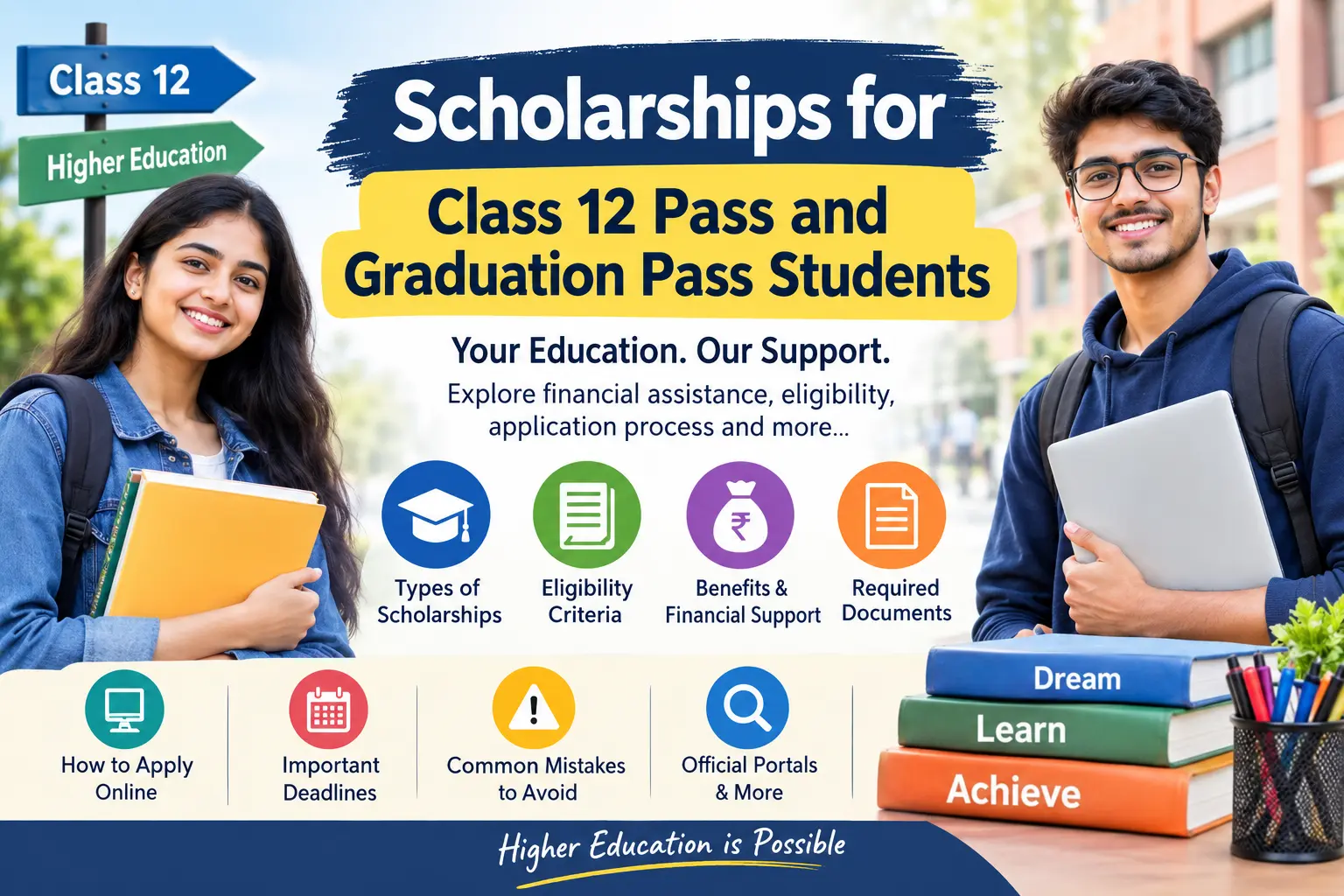
This is where scholarships can make a meaningful difference.
There are scholarships for students entering undergraduate courses after Class 12 as well as opportunities for graduates moving into postgraduate or professional programmes. These scholarships may be offered by the Central Government, state governments, UGC, universities, colleges and other recognised organisations.
However, not every scholarship is available to every student. Eligibility can depend on marks, family income, course, institution, category, state, age and other conditions.
This guide explains the important scholarship opportunities students should know about in 2026, how eligibility works, what documents are normally required, how to apply and where to verify the latest information.
Important: Scholarship amounts, eligibility conditions, application dates and verification procedures can change. The latest official notification should always be treated as the final authority.
What Is a Scholarship?
A scholarship is financial assistance provided to eligible students to support their education. Depending on the scheme, the assistance may contribute towards tuition, maintenance or other educational expenses.
Scholarships generally fall into several categories:
- Merit-based scholarships
- Merit-cum-means scholarships
- Government scholarships
- State-level scholarships
- UGC scholarships
- Category-specific scholarships
- Course-specific scholarships
- University and college scholarships
- Scholarships for students from particular regions or backgrounds
An important point for students is that a scholarship is not automatically awarded simply because you have passed an examination. Each scheme has its own eligibility and selection process.
Scholarships for Class 12-Pass Students
For students who have completed Class 12 and are entering college, one of the important central government opportunities is the Pradhan Mantri Uchchatar Shiksha Protsahan (PM-USP) Central Sector Scheme of Scholarship for College and University Students (CSSS).
The Ministry of Education describes PM-USP CSSS as a merit-cum-means scholarship. For fresh applications under the 2025–26 guidelines, eligible students generally need to be above the 80th percentile of successful candidates in their stream from the relevant Class XII board, pursue a regular course, have annual family income up to ₹4.5 lakh and not receive another scholarship or fee reimbursement. Diploma students and students who took a drop after Class 12 are excluded under those fresh-application conditions.
This is an important distinction: Class 12 marks alone do not guarantee the scholarship. The student must satisfy all applicable conditions.
Students should also investigate scholarships offered by their own state government. State schemes may have different income limits, academic requirements and application portals.
Ishan Uday Scholarship
Students from India’s North Eastern Region should also examine the Ishan Uday Special Scholarship Scheme.
UGC states that the scheme is for students who passed Class XII or equivalent from a school located in the North Eastern Region through a recognised board and have entered the first year of an eligible regular/full-time undergraduate degree programme. The current UGC information lists parental income below ₹4.50 lakh per year, 10,000 annual slots and financial assistance of ₹80,000 per year.
Therefore, students should not search only for generic “12th pass scholarships.” They should search according to their state, course, academic performance and personal eligibility.
Scholarships for Graduation-Pass Students
Graduation creates another major scholarship opportunity: postgraduate education.
Students entering MA, MSc, MCom, MTech, MPharm and other eligible postgraduate programmes can explore UGC scholarships as well as scholarships provided by universities and state governments.
National Scholarship for Post Graduate Studies
UGC’s National Scholarship for Post Graduate Studies is designed to provide financial assistance to Indian students pursuing eligible postgraduate degrees.
According to the current UGC information, students admitted to the first year of an eligible PG degree through regular/full-time mode can apply, subject to the scheme’s conditions. The scheme currently specifies an age limit of 30 years, 10,000 slots per year and financial assistance of ₹1.50 lakh per annum, with a two-year tenure.
Students should nevertheless check the latest notification for the academic year in which they are applying.
PG Scholarship for University Rank Holders
Graduates who performed exceptionally well in their undergraduate programme may have another opportunity.
UGC’s P.G. Scholarship for University Rank Holders is intended for eligible first- and second-rank holders at undergraduate level who are admitted to a postgraduate course. UGC currently lists 3,000 slots, a two-year tenure and financial assistance of ₹37,200 per year.
Scholarship for GATE/GPAT-Qualified Students
Students moving into M.E., M.Tech or M.Pharm after qualifying GATE/GPAT can also explore the UGC-listed PG scholarship for GATE/GPAT-qualified students.
UGC currently states that eligible students pursuing these full-time/regular programmes can receive ₹12,400 per month, subject to the scheme’s conditions.
Scholarships for SC/ST Students in Professional Courses
UGC also lists a PG Scholarship for SC/ST candidates pursuing eligible professional postgraduate courses on a full-time/regular basis.
The current UGC information lists financial assistance of ₹78,000 per year for M.E./M.Tech and ₹45,000 per year for other professional courses, with 1,000 slots.
Scholarship Eligibility Criteria: What Do Authorities Check?
There is no universal eligibility rule for scholarships in India. A student must examine the conditions of the individual scheme.
1. Academic performance
Some scholarships use marks, percentile, rank or examination performance as a selection criterion.
For example, the PM-USP CSSS fresh-application rules use a student’s position among successful Class XII candidates in the relevant stream.
2. Family income
Income is an important criterion in many government scholarships. But the income ceiling differs from one scheme to another.
Never assume that an income limit mentioned on an old website still applies.
3. Course
A scholarship may cover only specific undergraduate or postgraduate courses.
4. Institution
Some schemes require admission to a recognised university, college or institution and may specify regular/full-time study.
5. Category or special eligibility
Some scholarships are specifically designed for SC/ST students, single girl children, students from particular regions or other defined groups.
6. Age
Certain schemes impose an age limit. For example, the current UGC National Scholarship for Post Graduate Studies lists an age limit of 30 years.
Who Can Apply for These Scholarships?
In simple terms, the following students may find relevant opportunities:
Class 12-pass students: Students entering eligible undergraduate programmes.
Graduates: Students entering eligible postgraduate programmes.
Meritorious students: Students with strong academic performance or university ranks.
Students from economically weaker families: Where the particular scholarship has an income criterion.
Students belonging to specified categories: Where the scheme provides category-specific assistance.
Students from particular regions: For example, Ishan Uday is specifically designed for eligible students from the North Eastern Region.
The key is to match your profile with the scholarship—not the other way around.
Documents Required for Scholarship Applications
The exact document list depends on the scheme, but students should generally keep the following ready:
- Aadhaar or other accepted identity document
- Class 10 marksheet
- Class 12 marksheet
- Graduation marksheets, if applicable
- Admission/enrolment details
- College or university identity card
- Bank account details
- Income certificate, where required
- Caste/category certificate, where applicable
- Domicile certificate, where required
- Disability certificate, where applicable
- Passport-size photograph
- Signature
- Fee/admission receipt, where required
Before uploading anything, check the required file format, size and validity specified by the portal.
Also ensure that your name and date of birth are consistent across important documents.
How to Apply for a Scholarship Online
For many government scholarships, the National Scholarship Portal (NSP) is an important starting point. UGC’s Student Corner currently links students to the National Scholarship Portal, and several UGC scholarship pages direct applicants to NSP.
A typical application process is as follows.
Step 1: Find an eligible scholarship
Read the official notification from beginning to end. Check academic, income, course, institution, category and other requirements.
Step 2: Register on the official portal
Create an account using the information requested by the portal.
Step 3: Fill in personal and academic information
Enter your details exactly as they appear on your official documents.
Step 4: Add income and category information
Where applicable, enter the details of your income, caste, domicile or other certificates.
Step 5: Add bank details
Carefully verify your account number and other banking information.
Step 6: Upload documents
Upload clear and valid documents according to the portal’s instructions.
Step 7: Review before final submission
Check every field. Once an application is finally submitted, some details may not be easily editable.
Step 8: Complete verification
Depending on the scholarship, the application may need institutional, state or departmental verification.
Application submitted does not necessarily mean scholarship approved.
Students should continue checking their application status until the process is complete.
Scholarship Deadlines and Verification
One of the most common mistakes students make is searching for a single “scholarship last date.”
There is no single deadline for all scholarships.
Each scheme can have its own:
- Application opening date
- Application closing date
- Correction window
- Institute verification deadline
- State/department verification deadline
- Renewal deadline
- Payment-processing timeline
UGC’s website currently shows a 31 July 2026 public notice concerning the National Scholarship for Post Graduate Studies and Ishan Uday Scholarship Scheme through NSP, demonstrating why students should check current notices rather than rely on old scholarship articles.
Best practice: Apply several days before the deadline.
Do not wait for the final day, particularly when document verification or institutional approval is involved.
Common Scholarship Application Mistakes
A large number of problems can be avoided with basic care.
Applying without reading eligibility
A scholarship appearing in Google search results does not mean you qualify for it.
Entering incorrect information
A wrong marks percentage, income figure, date of birth or bank account number can create complications.
Uploading invalid certificates
Check whether your income, caste or domicile certificate meets the scheme’s requirements.
Ignoring verification
Students sometimes submit the application and never check whether their institution has verified it.
Missing the deadline
Set reminders for both application and verification deadlines.
Trusting unofficial information
YouTube videos, WhatsApp messages and third-party websites can contain outdated information.
Paying someone for a guaranteed scholarship
Be cautious of anyone claiming that a scholarship is guaranteed in exchange for money. Always verify the scheme through an official source.
What Students Should Check Before Applying
Before submitting a scholarship application, check five things carefully:
Eligibility: Do you meet every condition?
Course: Is your programme covered?
Institution: Is your college/university eligible?
Documents: Are all certificates valid and readable?
Deadline: Have you checked the latest official date?
Also check whether the scholarship permits you to receive another scholarship or fee reimbursement simultaneously. Some schemes specifically restrict simultaneous benefits; for example, the PM-USP CSSS fresh-application conditions state that the student should not be receiving another scholarship or fee reimbursement.
Useful Tips to Increase Your Chances of a Smooth Application
The best strategy is organisation.
Keep a digital folder containing your marksheets, certificates, photograph, signature and bank details. Keep both scanned and original copies available.
Check your college’s scholarship or student-welfare office because institutional verification may be required.
Bookmark official websites instead of relying on random Google results.
Most importantly, check the academic year. A scholarship article published in 2024 may show an amount or deadline that no longer applies in 2026.
UGC’s current Student Corner lists its active scholarship information, including Ishan Uday and the National Scholarship for Post Graduate Studies, and provides a link to the National Scholarship Portal.
Where to Check Official Scholarship Information
For the latest information, students should start with official sources:
- National Scholarship Portal (NSP)
- Ministry of Education, Government of India
- University Grants Commission (UGC)
- Your state government’s official scholarship/education portal
- Your college or university’s official website
The UGC Student Corner currently provides a dedicated scholarship section and links students to the National Scholarship Portal.
Conclusion
For students who have passed Class 12 or completed graduation, scholarships can reduce the financial burden of higher education and make it easier to continue studying.
Class 12-pass students should explore undergraduate scholarships such as PM-USP CSSS, state government schemes and institution-level assistance. Students entering postgraduate education should additionally check UGC scholarships and course-specific opportunities.
But students should remember one important rule: never judge a scholarship only by its advertised amount. Eligibility, course restrictions, income conditions, institutional requirements and verification rules are equally important.
Before applying, read the latest official notification, prepare your documents, submit accurate information and monitor verification and application status.
Scholarship rules can change from one academic year to another. Therefore, the official portal—not an old article, social-media post or forwarded WhatsApp message—should always be your final source of information.
Frequently Asked Questions
1. Can I get a scholarship after passing Class 12?
Yes. Eligible students entering undergraduate courses can apply for various central, state and institutional scholarships. Eligibility depends on the particular scheme.
2. Is there a scholarship after graduation?
Yes. Graduates entering eligible postgraduate courses can explore UGC, government, university and other scholarships. UGC currently lists the National Scholarship for Post Graduate Studies among its scholarship schemes.
3. What is the National Scholarship Portal?
The National Scholarship Portal (NSP) is a Government of India scholarship platform through which various scholarship schemes are administered. Students should use the official portal to check the schemes available to them.
4. Can Class 12 students apply for PM-USP CSSS?
Eligible students can apply subject to the scheme’s conditions. The current Ministry of Education information includes requirements relating to Class XII performance, regular study, family income and other conditions.
- Is a scholarship guaranteed after submitting the application?
No. Submission is not the same as approval. Applications may need institutional and/or government verification and must satisfy the complete eligibility requirements.
6. What documents are needed for scholarships?
Common documents include marksheets, identity proof, bank details, income certificate and category/domicile certificates where applicable. The exact requirements vary by scheme.
7. Can I apply for more than one scholarship?
It depends on the rules of the respective schemes. Some scholarships restrict students from receiving another scholarship or fee reimbursement simultaneously. Always read the official conditions before applying.
8. Where can I find the latest scholarship deadline?
Check the official scholarship portal and the website of the concerned ministry, UGC, state government or institution. Do not rely on an old article for the current year’s deadline.
Editorial note for publication: Because scholarship rules are updated periodically, this article should be reviewed against the relevant official notifications whenever a new academic session opens. The figures and eligibility details above have been checked against official government/UGC sources available in August 2026.