
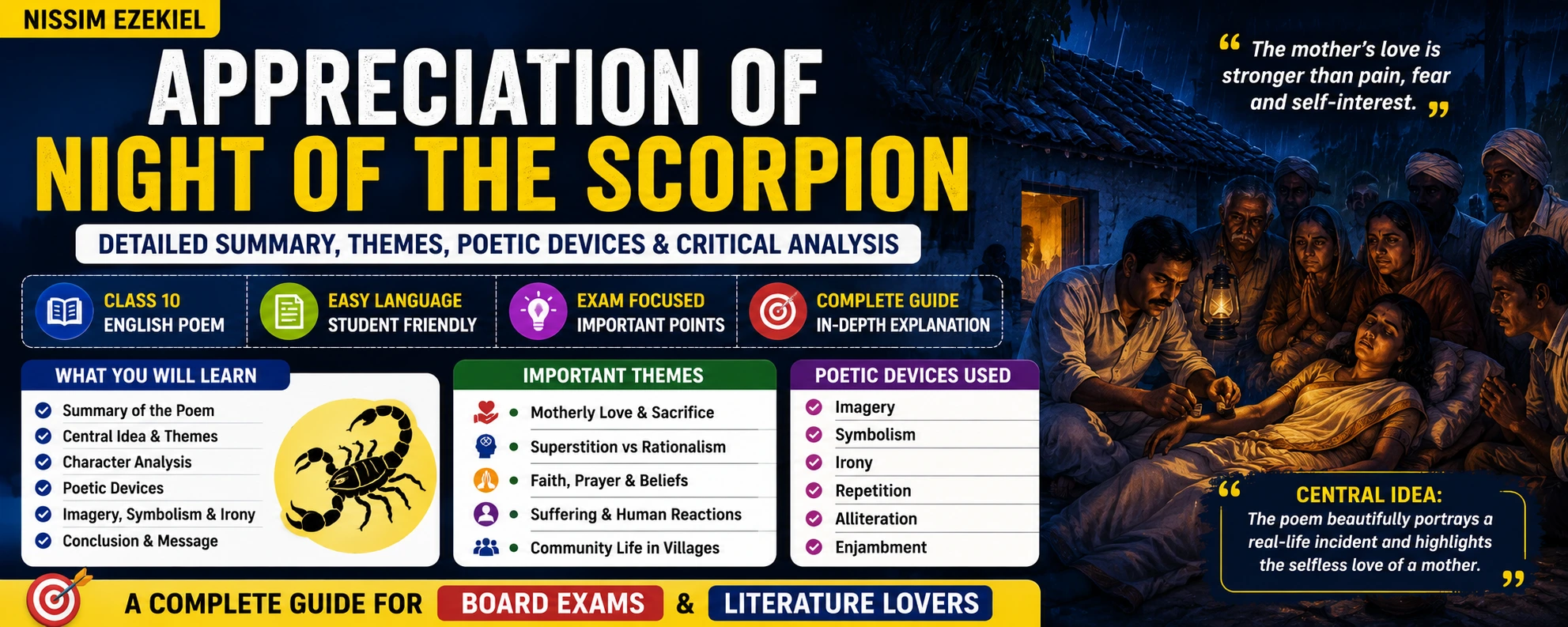
Night of the Scorpion” is one of the most widely studied poems by Indian English poet Nissim Ezekiel. It presents a dramatic incident from the poet’s childhood in which his mother is bitten by a scorpion on a rainy night. However, the poem is not merely about a scorpion bite. It explores village life, superstition, faith, rational thinking, human suffering and, above all, a mother’s selfless love for her children.
Students searching for the appreciation of Night of Scorpion should understand that the poem combines a simple domestic event with deep social and emotional meaning. Through realistic description, striking imagery and contrasting human reactions, Ezekiel turns an ordinary village incident into a powerful reflection on human nature.
Appreciation of Night of the Scorpion at a Glance
Point | Explanation |
Poem | Night of the Scorpion |
Poet | Nissim Ezekiel |
Genre | Narrative and reflective poem |
Form | Free verse |
Setting | A rural Indian home on a rainy night |
Main incident | The poet’s mother is bitten by a scorpion |
Major themes | Motherly love, superstition, faith, suffering and rationalism |
Tone | Tense, observant, ironic and finally compassionate |
Central message | A mother’s love is stronger than fear, pain and self-interest |
Rhyme scheme | No regular rhyme scheme |
Most important contrast | Superstitious villagers versus the rationalist father |
Ending | The mother is grateful that her children were spared |
AI Overview-Friendly Summary
“Night of the Scorpion” by Nissim Ezekiel describes how the poet’s mother is bitten by a scorpion during a night of heavy rain. Villagers gather in the house and respond with prayers, superstitions and traditional beliefs. The poet’s father, who considers himself rational, tries medicines, herbs and even fire to remove the poison. After suffering for many hours, the mother recovers. Instead of thinking about her own pain, she thanks God that the scorpion stung her and spared her children. The poem celebrates maternal sacrifice while also presenting the conflict between superstition and rationalism in rural Indian society.
About the Poet Nissim Ezekiel
Nissim Ezekiel was a major figure in modern Indian English poetry. His poems are known for clarity, irony, conversational language and close observation of Indian society. He often wrote about ordinary people, urban and rural life, family relationships, religious beliefs and contradictions in human behaviour.
In “Night of the Scorpion,” Ezekiel does not openly condemn or praise any single character. He observes the villagers, his father and his mother with sensitivity. His detached but compassionate style allows readers to notice the tension between faith and reason without forcing a simple conclusion.
Why Nissim Ezekiel Is Important
Nissim Ezekiel helped give Indian English poetry a distinct identity. His poems often use familiar Indian situations while expressing universal emotions.
His importance lies in his ability to:
- present Indian social life realistically;
- use simple English without losing depth;
- combine humour, irony and compassion;
- explore the conflict between tradition and modernity;
- turn everyday experiences into meaningful poetry.
Background and Setting of the Poem
The poem is set in a rural Indian household during a night of continuous rain. Because of the weather, a scorpion enters the house in search of shelter. It hides beneath a sack of rice and bites the poet’s mother.
The village setting is important because it explains the collective response to the incident. As soon as the news spreads, villagers arrive in large numbers. They do not remain passive spectators. They pray, offer explanations and attempt to support the suffering woman in the way they understand.
The house becomes crowded with human voices, religious beliefs, fear, shadows and hurried remedies. The event is therefore both private and public: one woman suffers, but the entire community participates in the crisis.
Detailed Summary of Night of the Scorpion
The poem begins with the poet remembering a night from his childhood. Rain had been falling continuously, and a scorpion had entered the house to escape the wet weather. It took shelter under a sack of rice.
The scorpion suddenly stung the poet’s mother and escaped into the darkness. The poet describes its movement as quick, dangerous and almost evil. The villagers began searching for it, but it had already disappeared.
Hearing about the incident, the peasants came to the poet’s house in large numbers. They carried lanterns and candles. Their shadows appeared enormous on the mud walls, creating an atmosphere of fear and confusion.
The villagers prayed and repeatedly invoked God. They believed that every movement of the scorpion caused the poison to move through the mother’s body. They also expressed several traditional beliefs about karma, suffering and purification.
Some villagers hoped that the mother’s present pain would destroy the sins of her previous birth. Others believed that her suffering would reduce the misfortunes of her next life. They treated pain as a spiritual process rather than only a medical emergency.
The poet’s father reacted differently. He was a rationalist and did not share the villagers’ religious explanations. However, in his anxiety, he tried almost every available remedy. He used powders, mixtures, herbs and even applied paraffin before setting the affected area on fire.
This creates an important irony. Although the father considers himself scientific and sceptical, fear for his wife makes him try methods that are not entirely rational.
The mother continued suffering for about twenty hours. Eventually, the effect of the poison disappeared and she recovered.
At the end, the mother does not complain about her suffering. She expresses gratitude that the scorpion chose her instead of her children. This final response reveals the poem’s deepest meaning: maternal love is instinctive, protective and selfless.
Stanza-Wise Explanation of Night of the Scorpion
The Scorpion Enters the House
The opening establishes the reason for the scorpion’s presence. It has not entered the home to attack anyone deliberately. It seeks shelter from continuous rain.
This detail makes the incident more realistic. Nature, weather and human life unexpectedly come into conflict. The scorpion acts according to instinct, while the family experiences its action as a terrifying disaster.
The Mother Is Stung
The sting happens suddenly. The scorpion immediately escapes after attacking the mother.
Its quick disappearance increases the fear of the people. Since the scorpion cannot be found, the villagers cannot kill it or confirm where it has gone. Its absence makes it more threatening because everyone imagines it moving somewhere in the darkness.
The Villagers Gather
The peasants arrive rapidly and fill the house. Their response demonstrates the strong community culture of village life.
They may be superstitious, but they are not indifferent. They leave their homes during a stormy night to support the family. Their presence represents social solidarity as well as traditional belief.
Prayers and Superstitious Beliefs
The villagers repeatedly pray and speak about karma, rebirth and purification. According to them, the mother’s suffering may remove past sins or prevent future misfortunes.
These beliefs show how people attempt to explain suffering when they do not have scientific knowledge or medical resources. Their statements may sound irrational, but they also help them emotionally manage fear and uncertainty.
The Father’s Remedies
The father represents modern rationalism. Yet the emergency exposes the limitations of his confidence.
He tries scientific and traditional methods without discrimination. His response suggests that when a loved one is in danger, even a rational person may become desperate enough to attempt anything.
The Mother’s Recovery
The poison finally loses its effect after many hours. The recovery is not clearly attributed to prayer, medicine, fire or the natural passing of time.
Ezekiel deliberately leaves the cause uncertain. This prevents readers from concluding that either superstition or science alone saved the mother.
The Mother’s Final Reaction
The ending is quiet but powerful. The mother is grateful that her children were not harmed.
Her statement transforms the poem. Until this point, the poem appears to focus on fear, superstition and suffering. The conclusion reveals that the true emotional centre of the poem is maternal love.
Critical Appreciation of Night of the Scorpion
The critical appreciation of “Night of the Scorpion” requires attention to the poem’s narrative structure, imagery, social observation, irony and emotional ending.
Title of the Poem
The title “Night of the Scorpion” is direct and memorable. It identifies both the time and the cause of the crisis.
The word “night” suggests darkness, uncertainty, fear and lack of knowledge. The scorpion represents physical danger, but it also becomes the centre around which different human beliefs and reactions emerge.
The title is effective because the poem recounts one unforgettable night that reveals the personality of an entire community and the depth of a mother’s love.
Central Idea
The central idea of the poem is that human beings respond to pain according to their beliefs, knowledge and emotions. The villagers respond with faith and superstition. The father responds with supposed rationalism and desperate experiments. The mother responds with silent endurance and selfless love.
Among all these responses, the mother’s reaction is the noblest. Her concern is not for her own suffering but for the safety of her children.
Theme of Motherly Love
Motherly love is the most important theme of the poem.
The mother experiences severe pain for many hours. Yet after recovering, she does not blame the scorpion, the villagers or the failed remedies. She is thankful because her children were safe.
Her final response shows that a mother often places her children’s well-being above her own comfort and safety. This makes the ending emotionally universal, even though the setting is specifically Indian.
Theme of Superstition
The villagers believe that the mother’s suffering is connected with karma, previous lives and future births. They also believe that the poison moves when the scorpion moves.
These ideas reflect traditional rural beliefs. Ezekiel presents them with irony, but he does not portray the villagers as cruel. Their prayers are sincere, and they genuinely wish for the mother’s recovery.
The poem therefore distinguishes between ignorance and lack of compassion. The villagers may lack scientific understanding, but they possess communal concern.
Theme of Rationalism
The father is described as rational and sceptical. However, he uses a mixture of medicines, herbs and extreme methods.
His behaviour suggests that rationality can become unstable during emotional crisis. Love and fear make him abandon consistent logic.
Through this character, the poet shows that the boundary between rational and irrational behaviour is not always clear.
Theme of Faith
Faith gives the villagers a language through which they can understand suffering. Their religious ideas help them believe that pain has some purpose.
The poem neither proves nor disproves their faith. Instead, it shows how belief becomes a psychological support during helplessness.
Theme of Suffering
The mother’s suffering is both physical and symbolic. Physically, she struggles with the poison. Symbolically, her pain becomes the subject of other people’s interpretations.
The villagers speak about her past and future sins, while the father experiments with remedies. The mother herself remains almost silent until the final lines.
This silence makes her suffering more dignified and powerful.
Conflict Between Tradition and Modernity
The villagers represent inherited beliefs, while the father appears to represent modern knowledge. However, the poem complicates this division.
The villagers show emotional unity but scientific ignorance. The father claims rationality but acts desperately. Neither side provides a completely convincing solution.
The mother’s love stands above this conflict. It becomes the only unquestionable truth in the poem.
Poetic Devices in Night of the Scorpion
Imagery
The poem uses strong visual, auditory and physical imagery.
Readers can imagine:
- rain falling continuously;
- the dark village house;
- lanterns and candles;
- large shadows on mud walls;
- villagers searching for the scorpion;
- the mother twisting in pain;
- the father applying different remedies.
The imagery makes the scene cinematic and emotionally intense.
Simile
The poet compares the movement or arrival of the villagers to a swarm. This comparison suggests speed, crowding and collective noise.
It also creates slight irony because the villagers gather almost automatically, driven by fear and curiosity.
Metaphor
The scorpion’s tail is described in language that associates it with evil. This metaphor reflects the human perception of the creature rather than its natural intention.
The scorpion becomes a symbol of sudden suffering and uncontrollable danger.
Alliteration
The repetition of consonant sounds gives rhythm to certain phrases and strengthens the poem’s musical quality.
Alliteration is not used merely for decoration. It often intensifies the movement, murmuring or confusion within the house.
Repetition
The villagers repeat prayers and beliefs. This repetition creates the effect of chanting.
It also reflects how traditional ideas are passed from one person to another without questioning.
Enjambment
Many sentences continue from one line to the next without a full stop. This is called enjambment.
Enjambment gives the poem a natural storytelling flow. It also creates urgency because the incident unfolds continuously, like a memory being recalled rapidly.
Irony
Irony is one of the most important techniques in the poem.
The father calls himself rational but tries contradictory and extreme treatments. The villagers’ beliefs sound unreasonable, yet their concern is genuine. The mother, who suffers the most, speaks the least and ends with the most meaningful statement.
Symbolism
The poem contains several important symbols.
The Scorpion
The scorpion symbolises unexpected danger, suffering and the destructive side of nature.
The Night
Night symbolises ignorance, uncertainty and fear.
Rain
Rain creates the situation that brings the scorpion indoors. It represents the power of nature to disturb ordinary human life.
Lanterns and Shadows
Lanterns represent limited human attempts to understand the crisis. The huge shadows suggest how fear enlarges danger in the human mind.
Fire
The fire used by the father represents desperate human intervention. It also shows how attempts to cure suffering may create additional pain.
Contrast
The poem is structured through contrasts:
- darkness and light;
- science and superstition;
- the father and the villagers;
- physical suffering and spiritual interpretation;
- fear and love;
- noise of the crowd and silence of the mother.
These contrasts give the poem intellectual and emotional depth.
Language and Style
The language of the poem is simple, direct and conversational. Ezekiel does not use an elaborate rhyme scheme or highly decorative vocabulary.
The simplicity is deliberate. It makes the poem accessible while allowing the imagery and human behaviour to carry the deeper meaning.
Narrative Style
The poem is written like a childhood memory. The poet narrates the event in sequence, beginning with the scorpion’s arrival and ending with the mother’s recovery.
This narrative structure keeps readers interested and makes the emotional conclusion more effective.
Realistic Style
The description of the village house, rain, peasants, mud walls, prayers and home remedies creates a believable Indian setting.
The poem does not romanticise village life. It presents both its warmth and its limitations.
Detached Observation
The poet rarely tells readers directly what to think. He records the villagers’ beliefs, the father’s actions and the mother’s response.
This detached style allows irony to emerge naturally.
Free Verse
The poem is written in free verse. It does not follow a regular rhyme scheme or fixed metrical pattern.
Free verse suits the poem because it sounds like spontaneous memory and natural speech.
Tone and Mood of the Poem
The tone changes as the poem progresses.
Ominous Tone
The opening creates an atmosphere of danger through darkness, rain and the sudden sting.
Anxious Tone
The arrival of the villagers and the search for the scorpion create tension and confusion.
Ironic Tone
The villagers’ beliefs and the father’s contradictory behaviour are described with mild irony.
Compassionate Tone
The mother’s suffering gradually shifts the poem from social observation to human sympathy.
Tender Tone
The final response of the mother creates tenderness and admiration.
The mood moves from fear to confusion, then to relief and emotional warmth.
Character Analysis
The Mother
The mother is the emotional centre of the poem. She is patient, strong and selfless.
She does not speak during the long period of suffering. Her only recorded response comes after recovery, when she expresses concern for her children.
Her silence is significant. While others interpret her pain, she simply endures it.
The Father
The father is educated, sceptical and anxious. He wishes to act rather than merely pray.
However, his experiments reveal desperation. He represents the limited power of reason when faced with personal fear and inadequate medical resources.
The Villagers
The villagers are superstitious but compassionate. They believe in karma, rebirth and religious purification.
Their ideas may not be scientifically valid, but they come together to support the family. They represent the strength and weakness of traditional community life.
The Scorpion
The scorpion is not developed as a moral character. It acts instinctively and escapes.
Yet in the minds of the people, it becomes evil and mysterious. This difference shows how humans give moral meaning to natural events.
Significance of the Ending
The ending is the most memorable part of the poem because it reveals the mother’s instinctive selflessness.
After suffering for many hours, she does not focus on her own pain. She is thankful that her children were spared.
The ending is effective for several reasons:
- It is emotionally unexpected.
- It contrasts with the long speeches of the villagers.
- It shows the mother’s strength without exaggeration.
- It gives the poem a universal message.
- It transforms a frightening incident into a celebration of love.
Message of Night of the Scorpion
The poem communicates several messages rather than one simple lesson.
First, it shows that people react differently to suffering. Some depend on religion, some on science and others on instinctive love.
Second, it suggests that education does not completely remove fear or irrational behaviour. Even the rational father becomes desperate.
Third, it presents the value of community. The villagers may hold superstitious beliefs, but they do not abandon the suffering family.
Finally, the poem celebrates maternal love as the purest response to suffering.
Is Night of the Scorpion Against Religion?
The poem is sometimes interpreted as an attack on superstition. However, it is more balanced than a simple criticism of religion.
The poet uses irony when presenting the villagers’ beliefs. Yet he also shows their sympathy, prayers and willingness to help.
Similarly, the father’s rationalism does not produce a clearly successful cure. The poem therefore questions blind belief but does not claim that scientific confidence always provides immediate answers.
Its deeper concern is human behaviour during crisis.
Why Is the Poem Still Relevant?
The poem remains relevant because the conflict between scientific knowledge and traditional belief continues in many societies.
During illness or emergency, people may consult doctors while also using home remedies, rituals or prayers. Families often combine modern treatment with inherited practices.
The poem is also timeless because maternal sacrifice remains a universal experience. Readers from different cultures can understand the mother’s concern for her children.
Exam-Oriented Appreciation of Night of the Scorpion
Short Appreciation Answer
“Night of the Scorpion” by Nissim Ezekiel is a narrative poem describing a night when the poet’s mother was bitten by a scorpion. The villagers gathered, prayed and expressed superstitious beliefs, while the poet’s rationalist father tried several remedies. The poem presents a contrast between faith and reason. It uses vivid imagery, irony, symbolism, repetition and free verse. The final response of the mother, who feels grateful that her children were spared, highlights selfless maternal love. Thus, the poem is both a realistic picture of rural Indian life and a moving tribute to motherhood.
Detailed Appreciation Answer
“Night of the Scorpion” is a powerful narrative poem by Nissim Ezekiel. It describes a childhood memory in which the poet’s mother is stung by a scorpion during a rainy night. Villagers gather with lanterns, pray to God and interpret her suffering through ideas of karma and rebirth. The poet’s father, although a rationalist, tries several traditional and scientific remedies in desperation. The poem is written in free verse and uses vivid imagery, irony, symbolism, repetition, contrast and enjambment. Its central themes include superstition, rationalism, suffering, community life and maternal love. The poem ends with the mother expressing gratitude that the scorpion did not sting her children. This conclusion gives the poem emotional power and shows the selfless nature of motherhood.
Points to Remember in an Examination
- Mention the poet’s name correctly.
- Explain the scorpion-bite incident briefly.
- Discuss both villagers and father.
- Identify the conflict between superstition and rationalism.
- Mention free verse and vivid imagery.
- Explain the significance of the ending.
- Conclude with the theme of maternal love.
One-Line Central Idea
The poem shows that while people respond to suffering through faith, superstition or reason, a mother responds through selfless love.
Quick Revision Note
Scorpion bite → villagers pray → father experiments → mother suffers → poison fades → mother thanks God for sparing her children.
Important Questions and Answers
What is the main theme of Night of the Scorpion?
The main theme is maternal love. The poem also explores superstition, faith, rationalism, suffering and village community life.
Why did the scorpion enter the house?
The scorpion entered the house to seek shelter from continuous rain.
How did the villagers react?
They gathered in large numbers, searched for the scorpion, prayed and offered traditional explanations about karma and suffering.
Why is the father’s behaviour ironic?
The father considers himself rational, but during the emergency he tries a mixture of scientific, traditional and extreme remedies.
How long did the mother suffer?
She suffered for about twenty hours before the effect of the poison disappeared.
What does the mother’s final response reveal?
It reveals her selfless love and willingness to suffer in order to protect her children.
What is the rhyme scheme of the poem?
The poem has no regular rhyme scheme. It is written in free verse.
What does the scorpion symbolise?
It symbolises sudden danger, pain, fear and the unpredictable power of nature.
What do the lanterns symbolise?
They symbolise limited human attempts to overcome darkness, ignorance and fear.
Is the poem critical of the villagers?
The poem gently questions their superstitions but also acknowledges their sympathy and community spirit.
FAQs on Appreciation of Night of Scorpion
Who wrote Night of the Scorpion?
“Night of the Scorpion” was written by Indian English poet Nissim Ezekiel.
What type of poem is Night of the Scorpion?
It is a narrative and reflective poem written in free verse.
What is the setting of the poem?
The poem is set in a rural Indian home during a rainy night.
What is the central conflict in the poem?
The central intellectual conflict is between superstition and rationalism, while the emotional centre is the mother’s love.
Why did the peasants come to the house?
They came after learning that the poet’s mother had been bitten by a scorpion. They prayed, searched and tried to support the family.
Did the father believe in superstition?
He considered himself rational and sceptical, but fear caused him to try many remedies, including some irrational ones.
What is the tone of the poem?
The tone is initially tense and fearful, later ironic and observational, and finally tender and compassionate.
What is the most important poetic device in the poem?
Imagery and irony are especially important. Symbolism, repetition, contrast and enjambment also contribute significantly.
Why is the ending memorable?
The ending is memorable because the mother ignores her own suffering and expresses gratitude that her children were safe.
What is the moral of Night of the Scorpion?
The poem suggests that selfless love, especially a mother’s love, can rise above pain, fear and conflicting beliefs.
Conclusion
The appreciation of Night of the Scorpion reveals that Nissim Ezekiel’s poem is much more than a description of a dangerous night. It is a realistic study of people under pressure.
The villagers respond with prayer and superstition. The father responds with reason, anxiety and desperate experiments. The mother responds with endurance and love. Through these different reactions, the poem explores Indian village life, religious belief, scientific thinking and human helplessness.
The poem’s free-verse form, natural language, vivid imagery, irony and symbolism make the incident believable and memorable. Its final emotional turn gives the poem universal value.
The mother’s gratitude for the safety of her children becomes the poem’s greatest truth. In a house filled with fear, arguments, prayers and remedies, her selfless love becomes the clearest and most powerful response.