
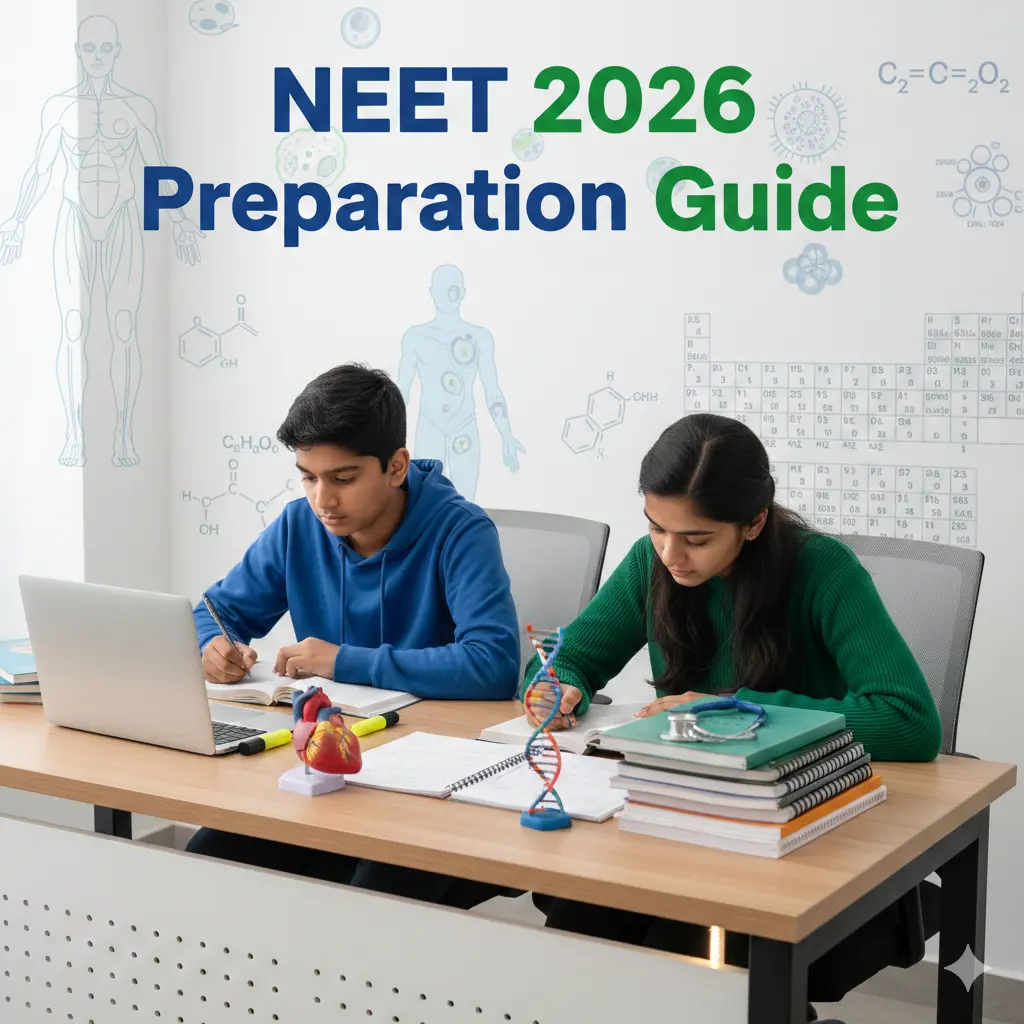
Preparing for the NEET exam is one of the most important academic journeys for students who dream of becoming doctors in India. Every year, lakhs of aspirants compete for limited MBBS, BDS, AYUSH, and other medical seats through the National Eligibility cum Entrance Test (NEET). Success in this exam requires proper planning, consistency, and a smart strategy.
If you are preparing for NEET 2026, this detailed guide will help you understand everything — from NEET exam preparation strategy, study timetable, exam duration, syllabus, and best books to a complete study plan designed for maximum results.
This article is a complete roadmap for beginners as well as repeaters.
What is the NEET Exam?
NEET (National Eligibility cum Entrance Test) is India’s single national-level medical entrance examination conducted for admission into:
- MBBS
- BDS
- BAMS
- BHMS
- BSMS
- BUMS
- Veterinary courses
- Nursing and allied medical programs
The exam is conducted annually by the National Testing Agency (NTA).
More than 20 lakh students appear every year, making NEET one of the toughest competitive exams in India.
NEET Exam Time Duration 2026
Understanding exam structure is the first step toward effective NEET exam preparation.
Expected NEET 2026 Exam Duration
- Total Time: 3 Hours 20 Minutes (200 minutes)
- Mode: Offline (Pen & Paper)
- Question Type: Multiple Choice Questions (MCQs)
Subject-wise Questions
Subject | Questions | Marks |
Physics | 45 | 180 |
Chemistry | 45 | 180 |
Botany | 45 | 180 |
Zoology | 45 | 180 |
Total | 180 | 720 |
Marking Scheme
- +4 marks for correct answer
- −1 mark for wrong answer
- 0 marks for unattempted
👉 Time management during these 200 minutes is extremely important.
NEET Exam Syllabus 2026 (Complete Overview)
The NEET syllabus is mainly based on the Class 11 and Class 12 NCERT curriculum.
Physics Syllabus
Class 11 Topics
- Units and Measurements
- Motion in One Dimension
- Laws of Motion
- Work, Energy & Power
- Rotational Motion
- Gravitation
- Thermodynamics
- Oscillations & Waves
Class 12 Topics
- Electrostatics
- Current Electricity
- Magnetism
- Electromagnetic Induction
- Optics
- Modern Physics
- Semiconductor Electronics
Chemistry Syllabus
Physical Chemistry
- Mole Concept
- Thermodynamics
- Chemical Equilibrium
- Electrochemistry
- Chemical Kinetics
Organic Chemistry
- Hydrocarbons
- Alcohols, Phenols & Ethers
- Aldehydes & Ketones
- Biomolecules
- Polymers
Inorganic Chemistry
- Periodic Table
- Chemical Bonding
- Coordination Compounds
- p-Block & d-Block Elements
Biology Syllabus
Biology carries 50% weightage, so it is the most scoring subject.
Class 11 Biology
- Diversity in the Living World
- Plant Physiology
- Human Physiology
- Cell Structure
Class 12 Biology
- Genetics & Evolution
- Biotechnology
- Reproduction
- Ecology
- Human Health & Disease
👉 NCERT Biology is considered the Bible for NEET.
NEET Exam Preparation Strategy (Step-by-Step)
Many students study hard but fail because they do not follow a proper strategy.
Here is the most effective NEET exam preparation approach.
1. Understand the Exam First
Before studying:
- Know syllabus
- Understand question trends
- Analyse previous papers
This saves time and prevents unnecessary study.
2. Focus on NCERT Books
Nearly 80–85% questions come directly or indirectly from NCERT.
Especially for Biology:
- Read every line
- Learn diagrams
- Memorize examples
3. Concept First, Practice Later
Wrong method:
Memorising formulas without understanding.
Correct method:
- Learn concept
- Solve examples
- Practice MCQs
- Analyze mistakes
4. Daily Revision Rule
Follow the 3-7-15 revision rule:
- Revise after 3 days
- Revise after 7 days
- Revise after 15 days
This improves long-term memory.
5. Practice Previous Year Questions
Solve at least:
- The last 15 years of NEET papers
- Chapter-wise PYQs
You will notice repeating patterns.
NEET Exam Study Time Table (Daily Routine)
A balanced timetable is essential.
Ideal Daily Study Schedule (12–14 Hours)
Morning Session (5 AM – 9 AM)
- Biology theory
- NCERT reading
- Diagram practice
Mid-Morning (10 AM – 1 PM)
- Physics concepts
- Numerical problems
Afternoon (2 PM – 5 PM)
- Chemistry theory + MCQs
Evening (6 PM – 8 PM)
- Revision of old topics
Night (9 PM – 10 PM)
- Mock test analysis
Weekly Study Pattern
Day | Focus |
Monday | Physics heavy |
Tuesday | Biology heavy |
Wednesday | Chemistry |
Thursday | Mixed Practice |
Friday | Weak Topics |
Saturday | Full Revision |
Sunday | Mock Test |
NEET Exam Study Plan (12-Month Strategy)
Phase 1: Foundation (Months 1–4)
Goal:
- Complete Class 11 syllabus
- Build concepts
Focus:
- NCERT reading
- Basic numerals
Phase 2: Syllabus Completion (Months 5–8)
Goal:
- Finish the Class 12 syllabus
Focus:
- Chapter tests
- Formula notes
Phase 3: Practice Phase (Months 9–10)
Goal:
- Improve speed
Focus:
- Mock tests
- PYQs
Phase 4: Revision Phase (Months 11–12)
Goal:
- Strengthen memory
Focus:
- Full syllabus revision
- Daily mock exams
NEET Exam Study Books (Best Recommended Books)
Choosing the right books saves time.
- NCERT Biology (Class 11 & 12) — MUST
- MTG NCERT at Your Fingertips
- Trueman Biology
Best Physics Books
- NCERT Physics
- HC Verma – Concepts of Physics
- DC Pandey Series (Arihant)
Best Chemistry Books
Physical Chemistry
- Narendra Awasthi
Organic Chemistry
- MS Chauhan
Inorganic Chemistry
- NCERT + JD Lee (selected topics)
Subject-wise Preparation Tips
Biology Preparation Tips
- Read NCERT 5–6 times
- Practice diagrams
- Memorise scientific names
- Focus on examples and tables
Target Score: 340+
Physics Preparation Tips
- Understand formulas deeply
- Solve numericals daily
- Practice 50 questions daily
Target Score: 150+
Chemistry Preparation Tips
- Learn reactions flowchart
- Revise inorganic weekly
- Practice equations daily
Target Score: 160+
Mock Test Strategy for NEET 2026
Mock tests are game changers.
How Many Tests?
- Before January: 1 per week
- January–March: 2 per week
- Last month: Alternate days
After Every Mock Test
Always analyse:
- Silly mistakes
- Time wasted
- Weak chapters
Improvement comes from analysis, not just tests.
Common Mistakes NEET Aspirants Make
- Ignoring NCERT
- Studying too many books
- No revision plan
- Avoiding mock tests
- Studying without a timetable
Avoid these mistakes to increase your chances of selection.
Time Management Tips During an Exam
Follow this order:
- Biology (45–50 minutes)
- Chemistry (45 minutes)
- Physics (60 minutes)
Keep the last 15 minutes for review.
How Many Hours Should You Study for NEET?
Student Level | Study Hours |
Beginner | 6–8 hrs |
Serious Aspirant | 10–12 hrs |
Dropper | 12–14 hrs |
Consistency matters more than hours.
Last 30 Days NEET Preparation Strategy
- Revise NCERT Biology daily
- Solve full-length mock papers
- Avoid new books
- Focus on weak chapters
- Sleep properly
Motivation Tips for NEET Aspirants
NEET preparation is a long journey.
Remember:
- Little daily progress = Big success
- Consistency beats intelligence
- Discipline creates rankers
Stay away from comparison and focus on improvement.
Final Revision Checklist
Before the NEET exam, ensure:
- All NCERT Biology revised
- The physics formulas notebook is ready
- Chemistry reactions memorised
- 50+ mock tests completed
- Sleep cycle fixed
Conclusion
NEET exam preparation is not about studying endlessly — it is about studying smartly and consistently. With a proper NEET exam study plan, a structured study timetable, the right books, and a deep understanding of the NEET exam syllabus, any dedicated student can succeed.